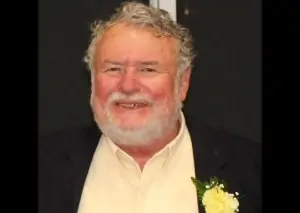
Dr. Richard Smith
On February 24, 2021, the Ferrum College community bid a last farewell to Professor of History and Williams Distinguished Teaching Professor in the Humanities Richard Lee Smith. He was a beloved husband, father, grandfather, and brother; a teacher and storyteller; an internationally recognized top scholar; an author; and a warm-hearted and generous member of the community. Smith was 75 years old.
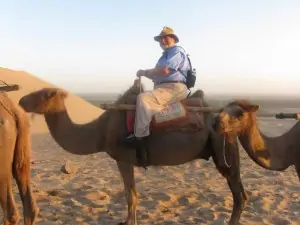
Smith rides atop a camel in the Taklamakan Desert.
Born on August 26, 1945 in Montgomery, WV, Smith spent his childhood in Cranford, NJ playing football and getting into things with his friends. He later moved to Moravia, NY where he worked on his family’s dairy farm during summers and attended college courses at SUNY-Cortland. He earned his bachelor’s degree in history in 1967 and then enrolled at Rutgers University where he received his master’s degree in 1969 and his Ph.D. in 1972, both in history.
After teaching for four years at LaGrange College in LaGrange, GA, Smith arrived at Ferrum College in 1976, where he would spend the next 42 years teaching history. As a college professor, Smith taught more than 8,000 students, over 7,000 of them at Ferrum College.
“Richard never waited until some other time to live life to its fullness. As was evident in the display of photographs at his retirement celebration in 2018, Richard leaned into life always,” wrote Ferrum College President David Johns in a recent email announcing Smith’s passing to the campus community.
“That his first students at Ferrum grew to be among his best friends is a testament to the impact he had on generations of Ferrum students,” said Professor of History Timothy Daniels, who was a colleague and personal friend of Smith’s.
He enjoyed teaching ancient Asian and African courses, including Chinese, Indian, Southeast Asian, North African, and sub-Saharan history, along with traditional Western European and American subjects. He was known to be a great storyteller who enthralled listeners with tales of his travels to the Sahara Desert, Timbuktu, Kenya, Egypt, Peru, and more. Some of these trips included his students who arrived home with hilarious stories and fond memories, including a rafting trip down the Tambopata River that ended in a crash and fire ant attack at their rainforest camp.
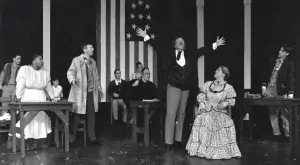
Smith performs in the Ferrum College drama production, “Too Free for Me” in 1998.
Smith authored three books, which earned him international recognition as a top scholar in ancient and medieval trade and commerce. At the time of his death, he was tirelessly working on a fourth book, a thematic study of trade and commerce in the ancient and medieval worlds.
“When Richard went into the hospital for some issues not directly related to his final medical problems, I told [his wife] Kathleen to relay to him that he’d better hurry up and get out of the hospital if he wanted to make progress on his book (which was four out of seven massive chapters done by the time of his death),” remembered Daniels. “She sent me a picture of him grinning in his hospital gown, in his hospital bed, with books and yellow legal pads splayed across his lap. Only death – not any illness – was going to get in the way of his scholarship.”
He appeared on Blue Ridge Public Television’s “Public Eye” program in the 1970s and 1980s, two PBS documentaries, and the television show “Digging for the Truth” with Josh Bernstein on the Discovery Channel. He also served as consultant for several History Channel shows.
Smith enjoyed performing for Ferrum College’s drama department and appeared in numerous plays including “Too Free For Me,” “Lil Abner,” “Fiddler on the Roof,” and more.
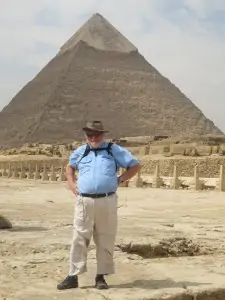
During a 2015 trip to Egypt.
He and his wife made their retirement home at Smith Mountain Lake in Wirtz, VA. There, he thoroughly enjoyed the water, captaining the boat that pulled his grandchildren across the lake during countless hours of tubing. He was a beer connoisseur and loved to grill, sharing his famous ribs and pulled pork platters with family and friends. Along with his limitless quest for knowledge, he loved music, organic gardening, and storytelling.
Once asked what he loved about Ferrum College, Smith responded, “Ferrum is special because it is a place where, as a teacher, I could help students maximize their potential if they were willing to work hard and dedicate themselves to achieving academic success. I am especially proud to see that so many of my former students have gone on to enjoy success in their chosen careers in business, public service, education, and a variety of other fields.”
“Some lives are so large, rich, and full, they spill over into the lives of others,” wrote Johns. “And not just an experience or a memory, but part of the energy and essence of that person becomes lodged inside those in his or her orbit. This was Richard, and there are many who carry within them part of the overflow of his extraordinary life.”
Smith is survived by his wife and soulmate Kathleen; sons Erik and Howard; step-children Kevin and Beth; and their families. Please share online condolences with the family here.
The family requests that memorial contributions be made to the Richard L. Smith Academic Enrichment Scholarship in History at Ferrum College.
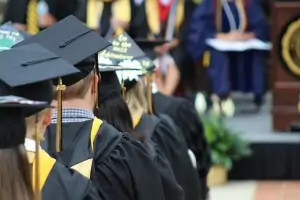
Ferrum College Commencement 2019
Ferrum College and Appalachian School of Law have entered into an agreement which will provide Ferrum students with an accelerated pathway to a career in the legal field.
“Our partnership with Appalachian School of Law is a natural fit,” said Ferrum College President David Johns. “ASL’s mission of providing community leaders and community advocates builds upon the work we do, and this partnership is one more way for Ferrum College to serve our students, our community, and our region.”
ASL President and Dean Elizabeth A. McClanahan agreed, saying that 3-plus-3 partnerships “provide students with an aspirational architecture for constructing their own futures.”
“This focused approach is particularly important,” she observed, in a time where students are searching for “a strong, reliable hope for an ordered and meaningful future.”
The program, known as a 3-plus-3 Dual Degree Agreement, will allow students to enroll at ASL after three years as an undergraduate at Ferrum College. Ferrum students will receive their baccalaureate degree after completing their first year of law school at ASL, and will then receive a law degree two years later. This efficient pathway to a law degree allows graduates to begin working in the legal field in less time and with less expense.
Admission to ASL is guaranteed for Ferrum students as long as they are on track to receive their bachelor’s degree by the end of the semester after application to ASL, maintain a minimum cumulative 3.0 grade point average, and earn an LSAT score equal to or exceeding 150.
“Every partnership Ferrum College makes is developed with our students and community in mind, and we are delighted to be able to share news of our agreement with the Appalachian School of Law,” said Provost and Vice President for Academic Affairs Aimé Sposato.
Learn more about Ferrum College’s criminal justice program here.
 Ferrum Family:
A new semester is here and, like the last two, it will be different from others we have known. So, I want to take a moment to think about our work these next few months.
We are all getting very good at adjusting to this COVID world–HyFlex instruction, remote service and interaction, Zoom meetings, and holding things together, even while not having a map for this territory. I am proud of how we have risen to the challenges that have become part of our daily lives.
This semester begins, however, with our country on edge.
Pandemic fatigue has been washing over us for months and it can be overwhelming. And, as happens so often, a public health crisis is laying bare the social and economic disparities that have existed in our country for generations.
As we know too well, the fabric of society is not woven tightly, and a tug on loose threads is all that is needed to unravel the whole. Strains are coming from many corners, and the din is growing harsh, louder, and more dangerous.
In this time of diversivolent rhetoric, questionable loyalties, and sharply drawn battle lines, there is a temptation to rally our kin, raise our voices, and flood the world with vitriol that rivals that of the ones with whom we disagree.
But this will destroy us all, because when the anger and insults subside, and the violence falls away, how will we determine who was right and who was wrong?
At Ferrum College, we often do things differently than what happens in the public square. We try to model intelligent, contextualized, and socially principled conversation, the kind sorely lacking right now. We make the bold claim of encouraging critical thinking, creativity, and communication skills. We announce that we challenge students to strive for excellence and to be global citizens in a welcoming and supportive community. And, we undergird all of this with a moral vision that places the concerns of others before our own, Not Self, but Others.
To state it plainly: our work in the weeks ahead is to excel at what we do, and to become an even better version of ourselves. As Martin Luther King, Jr. remarked, “Whatever your life’s work is, do it well.” Thus, those things we encourage in our students, we practice ourselves; what we wish for in society, we embody in our life together. We are fortunate to be in a position to add to the country’s store of goodness and clarity and generosity and truth.
Who we are as a community is itself a witness to a better way. That is a tall order, I realize, but I believe we are up to the task because it is what we do each and every day. I look forward to walking together this new year in ways that bring a little more understanding and peace to our nation.
David L. Johns, Ph.D.
Ferrum College President
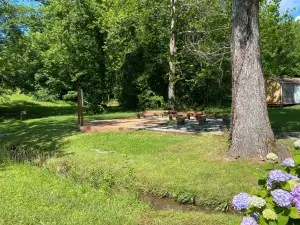
The Outdoor Classroom is located near the Fitness Center & the Ferrum Outdoors building.
Ferrum College is preparing for another unique semester as the COVID-19 pandemic continues. The College plans to closely follow the same protocol that it adopted for its fall 2020 semester, which allowed students to remain on campus and successfully complete their fall courses through hybrid instruction (half virtual, half in-person).The most striking difference is that Ferrum’s athletes will now be back in action this spring.
Spring semester classes will begin on Tuesday, January 19, 2021. Students are required to check-in online prior to utilizing a staggered schedule to move back to Ferrum’s campus. They are also instructed to limit their exposure and monitor their health and temperature daily for 14 days prior to their arrival.
Students, faculty, and staff will follow the same protocol this spring as they did last semester: wearing masks during class and at work, limiting people in buildings on campus, practicing social distancing, and using the LiveSafe app to check in daily before leaving their residence halls and/or coming to campus. Housekeeping staff will continue performing both routine and deep cleaning on campus, especially for high-touch areas like light switches and door handles.
The College’s athletic teams will compete this spring; however, due to COVID-19 restrictions, spectators will not be allowed to attend indoor sports and are instead encouraged to enjoy indoor sporting events at this livestream link. A decision regarding spectators for outdoor sports events has not yet been made. Read more about Ferrum’s spring athletics season in this letter from Director of Athletics John Sutyak.
Additionally, the College is exploring the creation of a campus vaccination center as the COVID-19 vaccine becomes more available this spring. “We are hopeful for an inoculation center on campus when the vaccine gets to 1C in spring, so those who are interested can have easy access to vaccinations,” wrote Dean of Students and Pandemic Coordinator Nicole Lenez in a campus-wide email earlier this week.
Although cautious, the Ferrum College community remains optimistic for another successful semester. “I am eager for our Panther family to begin a new semester,” wrote President David Johns in recent campus correspondence. “We will support each other through the challenges of this pandemic, encouraging each other to excel in the classroom, the court and field, in the residence halls, and in our neighboring communities. With determination and a renewed sense of purpose, we will continue to practice those things that make for a better tomorrow.” Read Johns’ full letter here.
Visit www.ferrum.edu/stronger-together to learn more about spring semester 2021.
President David Johns
The assault on the United States Capitol was a wake up call, a reminder that democracy is precious, democracy is fragile, and that democracy requires us all.
A longing for freedom, a longing to be heard above the crowd and to build a society with enough room for those we love, runs deep in the American spirit. Yet, how quickly these can become the very things that separate us and make us enemies to each other.
G.K. Chesterton once remarked that the line that divides good and evil is not a line between two people, but a line that passes through each individual heart. Each of us possess all that is necessary to do extraordinary good. Some, with very few resources, have transformed the world because they fed the better angels of their nature.
On the other hand, each one of us possess all that is necessary to destroy the world, and ourselves with it.
What erupted into chaos, destruction, and death at the Capitol was the cumulative effect of years of failing at the small things that build civil society. Listening, fairness, self-discipline, openness to the Other, and telling the truth. When we ignore these simple gestures, the greater things we desire are beyond our grasp.
It is tempting to rationalize and justify violence, destruction, and incivility when it erupts in support of something for which we care deeply. Self-righteous myopia is not a flaw of the right or of the left, it is a human shortcoming we must all avoid.
Here at Ferrum College, everything we do is preparing us to be generous, free, and responsible citizens. How we disagree with each other, the way we embrace our diversity, and our abiding commitment to ‘Not Self, but Others,’ give us the tools we need to build a society stronger and better than what we saw last week.
I am eager for our Panther family to begin a new semester. We will support each other through the challenges of this pandemic, encouraging each other to excel in the classroom, the court and field, in the residence halls, and in our neighboring communities. With determination and a renewed sense of purpose, we will continue to practice those things that make for a better tomorrow.
David L. Johns, Ph.D.
President
President David Johns
(January 6, 2021) One of my teachers used to say that no one should publish a book before turning 50. That was overstated, to be sure. However, J.D. Vance’s “Hillbilly Elegy” is a good example of why memoirists ought to have gray hair.
“Hillbilly Elegy” became a New York Times bestseller shortly after its release in 2016, and it has sold more than 3 million copies. Its soaring popularity is due in part to its portrayal of misunderstood and politically forgotten America, an America that overwhelmingly voted for Donald Trump.
Because of good luck or bad timing, Vance was quickly regarded as a spokesperson for disaffected Appalachia. Yet, his tempestuous family tale sits heavy in the stomach of some he claims to describe.
But, it’s important to note that Vance does not claim to be the voice of Appalachia. He is criticized by some for presenting an universalized view of the area and its people; but really, who in their right mind would ever claim to speak on behalf of an entire region? Vance certainly did not.
Some of his critics published a collection of essays, “Appalachian Reckoning: a Region Responds to Hillbilly Elegy.” This is a book-length tug of war for who can speak truthfully about Appalachia. The essays range from mildly appreciative to excoriatingly Vance-shaming, denouncing the memoir as a deeply flawed, imperfect story that is out of tune and out of touch.
It is true, however, that the public often rushes to stereotype and generalize because it’s easy, and because it has little patience for the complexity of just about everything, including Appalachia, and including 2016. Impatience made “Hillbilly Elegy” something more than it ever should have been: a singular memory of one young man’s family.
The story is now filtered through Ron Howard’s lens, and he fills the screen with poorly drawn caricatures of Appalachia set against a backdrop of beauty, addiction, and poverty. But like most stories we tell, this one is true only in part.
I am projecting my own experience on Vance, I realize, but my background is similar to his. He grew up in Ohio, so did I. His family was from Kentucky, mine was from West Virginia. We both left in the pursuit of education and careers — a law degree for Vance, a PhD for me.
My mother grew up in the hollers near Coburn, West Virginia, where I spent time as a child. Family networks there were tight and extensive; family secrets, which were never secret, ranged from shocking to comic. My maternal side of the family emigrated to Ohio looking for work in the rubber plants in Akron and in the warehouses at the Diebold Safe and Vault Co. in Canton, Ohio, where I was born.
Vance was 32 when Elegy was published, but I will subtract a year or two for writing and shopping the manuscript to publishers, and assume he was 30 years old when Elegy was written.
When I was 30 or 32, I was completely unprepared to tell my family’s story. I was still too angry and ashamed. I was still differentiating from my Appalachian upbringing, a decade away from acknowledging the courage and wisdom of my blue collar family.
Vance may be able to tell his family’s story better than I would have been able to tell mine nearly 30 years ago. I would have been unkind and unfair. Nevertheless, rather than silence his voice, I would like to see Vance tell his story again after he turns 50.
Our perspectives change over time and we make peace in new ways with the people and places we have left behind. We are more measured and more tentative in our generalizations and in our depictions.
I admit, my remarks are more confession than critique. These days I am ashamed for having ever been ashamed of my Appalachian birthright, for having bought into a belief that I had to “move out to move up.”
We lose a lot when we think this way, and I have spent decades recovering what I cast aside so cavalierly as a young man. I cannot and will not say that this is Vance’s experience, but it was mine. For me, admittedly a slow learner, it has taken years to become proud of my Appalachian roots, and to embrace my family, so precious and real and flawed and perfect.
And to let each one of them live inside of me.
This column by President David Johns appeared in The Roanoke Times and The Franklin News-Post. President Johns may be reached at president@ferrum.edu.
(December 8, 2020) I relived the pandemic while packing to move.
Each plate, bowl and glass got its own section of newspaper as I wrapped them and tucked them carefully inside boxes. Coffee mugs wrapped in January’s news — hints of a virus likely to spread widely. Ceramic pitchers padded in February’s announcements of infections and the first U.S. death. Next came bottles of spices and olive oil wrapped in the WHO’s proclamation that the virus had reached pandemic scale. Then came lockdowns, layoffs, business implosions and, finally, some promise of light at the end of the tunnel.
We went into the new year as we usually do, full of hope, ready for challenges and opportunities. And, we found both.
Like everyone else, I am ready to say good riddance to 2020. However, when we step back for a moment and reflect, it’s remarkable what we have learned and what we have accomplished.
First, we have learned that we are stronger than we thought we were, and that we are even stronger when we work together.
Each of us has strength we didn’t know we had. We didn’t need it, quite frankly, until this year, but when circumstances pinned us into a corner, we found determination and creativity sufficient to move forward. We discovered, in the midst of enormous challenge, what Thomas Edison meant when he said: “When you’ve exhausted all possibilities, remember: you haven’t.”
Second, we learned that we need very little to survive.
Throughout the pandemic, we have pared back many of the activities that filled our lives last year. We have spent less money on some of the odds and ends we generally give away or throw away. While we might miss some of these things and some of these activities, and while we may be eager for their return, we are fine. We have survived, and we are not diminished.
Third, we have learned we can work, learn and play at a distance.
Not all work, I realize, nor all learning, nor all play. But with imagination and willingness, we have been able to do more than we thought we could back in March. Fears that technology would isolate us from each other are unfounded. Had this pandemic occurred 30 years ago, we would have been isolated from each other for days on end. However, in 2020, we were able to quarantine and at the same time keep many aspects of life moving along.
And finally, we have learned that friends and family really are what matter most.
As the pandemic chiseled away at our social calendars, our work schedules and our weekend plans, many of us found ourselves reconnecting with a core circle of friends. We realized that the people who know us best and love us most were the ones who could help us stay balanced and keep our lives in perspective during these unusual times. Travel restrictions and limited crowd mandates did not prevent us from finding ways to stay close.
Wrapping dishes in back issues of newspapers gave me a whirlwind review of how far we have come in just a few months. It was strange to read articles from February and March having already lived through September and October. We know now what we did not know then, but we do not know today what lies ahead in February 2021, or April, or ….
We live our lives forward, as Soren Kierkegaard said, but only understand them in reverse. So, we need to be content to know very little. Yet, we can all hold on to what we have learned, those things that have carried us up to this point and that can, I believe, carry us farther still. We are stronger than we could ever have imagined, and even stronger together; we need very little to survive; we can work, learn and play at a distance; and friends and family are really what matter most.
One day, the COVID-19 pandemic will be the stuff of documentaries and history books, and our children will tell stories about it to their children. And soon, someone will wrap dishes in the yellowed pages of newspaper articles that report about vaccines, antibodies, of rebuilding society, and about a world made better because it struggled together.
This column by President David Johns appeared in The Roanoke Times and The Franklin News-Post. President Johns may be reached at president@ferrum.edu.
 12/3/2020
Ferrum College celebrated #GivingTuesday on Tuesday, December 1, 2020 with an invitation for donors to be “Ferrum Bold” by making a gift of any size to any program. The College ended the day with gifts totaling a record-breaking $56,786 from over 260 donors.
As part of this year’s #GivingTuesday, Ferrum participated in a two-part challenge issued by the Jessie Ball duPont Fund: if the College raised at least $25,000, the duPont Fund would match it with another $25,000. Additionally, if at least 200 people made donations through the College’s website on Giving Tuesday, the duPont Fund would kick in another $25,000, bringing the total to an extra $50,000 for Ferrum College.
Ferrum met both requirements to receive the combined $50,000 in challenge gifts, bringing the total amount raised to $106,786.
“This Giving Tuesday was another reminder of the generosity and overwhelming support Ferrum receives from its alumni, faculty, staff, and friends,” said President David Johns. “The impact of Tuesday’s gifts will be felt for years to come.”
The theme for this year’s Giving Tuesday was “Ferrum Bold” and focused on stories of students and alumni who embody the toughness and resiliency that Ferrum has adopted this year through the slogan: Ferrum Means Iron.
“At a time when we are all being pulled in multiple directions, I am truly in awe of our supporters’ generosity,” said Vice President for Institutional Advancement & External Relations Wilson Paine. “I am so proud of the Ferrum family and the Institutional Advancement team for their commitment to our students and programs.”
Per their website, the Jessie Ball duPont Fund “is committed to creating communities of belonging for the people, organizations and places that [philanthropist, businesswoman, and community steward] Jessie Ball duPont knew and loved.” Visit here to learn more.
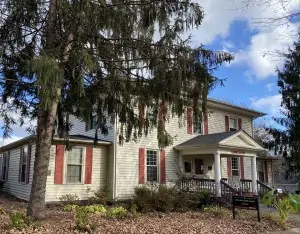
The Admissions Office is located in the Spillman-Daniel House on Ferrum College’s campus.
Ferrum College announced today that it will not increase full-time undergraduate tuition rates for the 2021-22 academic year. The College also guarantees that tuition will not increase cumulatively more than five percent from Fall 2021 to Spring 2025, and notes the average four-year scholarship and grant package will be over $100,000.
“This is just one of the ways in which we are responding to the financial toll this year has had on our students and their families because of COVID-19,” said President David Johns. “Ferrum College is committed to remaining one of the most affordable colleges in Virginia, and now we’re making it official.”
Annual tuition for the current 2020-21 academic year is $36,480 before any institutional aid. The College awards over $20 million in institutional aid each year, and 99 percent of its students receive some kind of financial aid through scholarships and grants, loan programs, and work study opportunities.
“We recognize the importance of continuing to provide a quality, well-rounded, affordable education in a safe environment,” said Senior Enrollment Officer Eric Grundman. “By freezing our full-time undergraduate tuition for the 2021-22 academic year and capping future full-time undergraduate tuition increases to no more than five percent cumulatively through the spring semester of 2025, Ferrum College will remain one of the most affordable private colleges in the Commonwealth of Virginia. This will allow families to plan and budget for the future because it relieves the stress and uncertainty of not knowing future tuition rates.”
Applying to Ferrum College is easy and free. Visit here to learn more and apply.
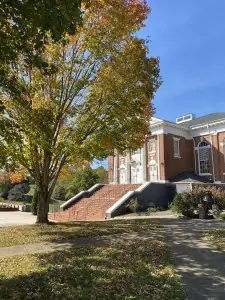 On November 12, 2020, Ferrum College received full approval to become a Level IV institution that will allow the College to offer a variety of masters and specialist level programs. This approval came after a Southern Association of Colleges and Schools Commission on Colleges (SACSCOC) review team determined that Ferrum is 100 percent in compliance with every standard and made no additional recommendations.
“We have all worked very hard over the last few years to reshape the College, to encourage leadership, to build positivity, and to dream big. The excitement we feel today is a direct result of a daily commitment to our students, of putting our motto, Not Self, But Others, into practice, and of working together, side by side, for the good of Ferrum College and for a better tomorrow,” wrote President David Johns in a campus-wide email announcing the College’s accomplishment.
In January 2020, SACSCOC approved Ferrum to begin offering two graduate programs in the fall of 2020: a Master of Science in psychology and an Education Specialist Degree (EdS) in teacher leadership and coaching. Prior to then, Ferrum had educated students first as a training school, then as a junior college, and finally as a four-year institution.
This is the second time that a SACSCOC review team has evaluated Ferrum College in less than two months. The first evaluation occurred in September 2020 and assessed the institution’s programs and operations in order to approve reaccreditation, a process that is completed every 10 years. SACSCOC’s initial visit also resulted in a glowing report and gave no additional recommendations.
In his email, Johns noted how rare it is for an institution to receive final SACSCOC reports that find a college to be 100 percent in compliance and make no additional recommendations: “…We have accomplished it not once, but twice…and during a global pandemic,” he wrote.
Learn more about Ferrum College’s graduate programs here.
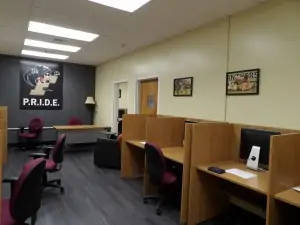
The newly renovated Carter Center for Academic Success includes a space for the PRIDE program, which focuses on academic & personal excellence for student-athletes. Donna Winge photo.
In the summer of 2020, the Carter Center for Academic Success, formerly known as the Academic Resources Center, received a facelift thanks to alumnus Maury Carter ’53 and his family.
“Seven siblings from my generation were Ferrum scholars,” said Carter. “Ferrum College provided more than a college textbook education. Taught there was an outstanding education, but equally important: compassion.”
“It is an exciting time for those of us who work in the Carter Center for Academic Success,” said Dean of Student Success and Assistant Professor David Wiggins. “Now the Carter Center is even more beautiful and functional. The students are thankful for a place where they can study individually or collectively, get peer-assisted tutoring, and learn new skills to help them with their academic success. We are very grateful to the Carter family for their gift.”
Located on the lower level of Ferrum College’s library, the newly renovated Carter Center is open 24 hours a day and boasts all new furniture, paint, carpeting, and ceiling tiles, plus a new camera and monitoring system. It provides resources and services to help students achieve their greatest academic potential, including one-on-one tutoring support, individual advising sessions, study groups for first-year students and military veterans, and support for students with learning differences.
Carter’s family was not financially secure during the College’s early days. “A family of ten. Mom and Dad and eight siblings,” remembered Carter. “A poor family a bit different from the students from more populated areas. Our parents could not have afforded to send any of us to college. Ferrum College made the dream of attending college possible for our family. The professors understood us and taught us well.”
After graduating from Ferrum, Carter went on to enjoy a successful career in real estate investment, primarily in Virginia and central Florida. Based in Orlando, Maury L. Carter & Associates has closed approximately $1,500,000,000 in real estate transactions on over 200,000 acres of land since the 1990s.
“The Carter family moved to Ferrum in 1914, one year after the College opened, and have been part of the Ferrum story ever since,” explained Vice President for Institutional Advancement Wilson Paine ’07. “This gift represents over one hundred years of support from the Carter family, and is a testament to their commitment to our students, the College, and the region.”
“I love the people there,” said Carter. “I love the town and Ferrum College. When I am on the College’s campus, I have a special feeling: a feeling of being at home.”
Learn more about the Carter Center for Academic Success by visiting here.
Read 1953 alumnus Maury Carter’s full thoughts below:
“‘Not Self, But Others.’ Ferrum College provided more than a college textbook education. Taught there was an outstanding education, but equally important: compassion. ‘Not Self, But Others.’
“There in them hills was a family called Carter. A family of ten. Mom and Dad and eight siblings. Seven siblings from my generation were Ferrum scholars. A poor family a bit different from the students from more populated areas. Our parents could not have afforded to send any of us to college. Ferrum College made the dream of attending college possible for our family. The professors understood us and taught us well.
“I believe my brother began attending Ferrum around 1920. Many of our family members have attended during our 100 year relationship with Ferrum College.
“On a personal note, I say that Ferrum College kept me out of tanks in Korea. I graduated in 1953 and entered the U.S. Army. After the rigorous basic training, we were being assigned locations, most to Korea. Out of a group of several hundred, I was selected to serve as a personnel specialist. This assignment taught me how to perform in an office environment and it prepared me for a position in aerospace.
“I love the people there. I love the mountains. I love the town and Ferrum College. When I am on the college campus, I have a special feeling: a feeling of being at home.”
For an in-depth account of Carter’s early life and achievements, please visit the Maury L. Carter & Associates, Inc. website.
 Panther Nation:
We are only a few days from the 2020 presidential election. The usual ramp-up to November has been intensified this year by the uncertainly of a global pandemic, a public health challenge that has remade our world in a matter of months. It also comes at a time when our country is thinking hard about its history and how to reckon with racism and social injustice. While every election is weighty and momentous, this one is especially so for these reasons, and more.
I am proud of how our college community works together through difficulties, how we celebrate together in moments of triumph, and how we treat each other with respect and grace when we disagree. This always serves us well, and it will do so in the weeks to come.
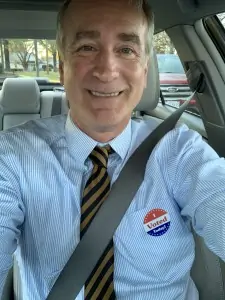
For some of you, this will be the first election in which you are eligible to vote. What a memorable day November 3 will be for you! Others of us have voted for decades and next Tuesday will be no less important. Each of us goes to the polls with a commitment to the future and with a steady belief that the messiness of democracy is worth it. At the very heart of being an American is unwavering optimism that, as Harry Emerson Fosdick once remarked, “… there are extraordinary possibilities in ordinary people.”
I urge you, if you are eligible and registered, to please vote. It is one small way we participate in self-governance, and one huge expression of gratitude for the women and men who have sacrificed their lives over the centuries to ensure we enjoy this freedom.
I urge you also to be kind to one another, to treat each other on Wednesday, November 4 the way you do today. As Lincoln stated in his second inaugural address: “with malice toward none; with charity for all.”
Inevitably, some will be more enthusiastic and hopeful about the elections’ results than others. But whether on Wednesday we celebrate or whether we are disappointed, we remain family and we need each other. Every day, this community embodies an array of ideas of how to build the future, of how to achieve “a more perfect union;” nevertheless, we are joined together by a fundamental belief that our lives are better, fuller, and richer, when we live them together, and when we live them for each other.
With Panther (and American!) pride,
David L. Johns, Ph.D.
President