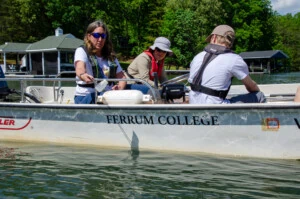
 The Smith Mountain Lake Volunteer Water Quality Monitoring Program (SMLWQMP), administered by scientists from Ferrum College in collaboration with the Smith Mountain Lake Association (SMLA), is celebrating its thirty-sixth anniversary this year. Initiated in 1987, the program has functioned each year to monitor the water quality in Smith Mountain Lake and to encourage active participation of the lake community in protecting this resource.
Each summer, Ferrum College faculty, students, and SMLA representatives and volunteers monitor the lake water for nutrients, bacteria, and algal blooms. Stakeholders and local health departments use collected data to inform the community of any concerns.
Ferrum College Professor of Environmental Science and Smith Mountain Lake Water Quality Monitoring Program Director Delia Heck has been an integral part of the program for 17 years. “For me, the SMLWQMP is an excellent example of the synergy possible between academia, citizen scientists, government agencies, industry, and regional advocacy groups to ensure the viability of our water resources. Ferrum College faculty, staff, and students work closely with the Smith Mountain Lake Association and its members on a weekly basis to run the program. This work wouldn’t be possible without the support of Appalachian Power Company, Bedford County Regional Water Authority, Smith Mountain Lake Association, Virginia Department of Environmental Quality, and Western Virginia Water Authority.”
“I am the intern responsible for the total phosphorus portion of the water quality project,” said student intern and Ferrum College senior Emma Brubaker. “I love this project. Working under and learning from these professors has already been one of the best experiences I’ve had. I can’t wait to see everything I learn this summer while doing something I love.”
Ferrum College senior and student intern Shane Hernandez’s family visited Smith Mountain Lake long before he was ever born. He has many wonderful memories of the lake and feels great to be able to do something for the lake and the community. “My job is to collect, analyze, and identify algae samples. While it is not the most entertaining job, I still find a great amount of satisfaction knowing that I am helping the community. It is awesome to learn more about the lake I have spent most of my life on.”
“I’m one of the main leaders on bacteria sampling and analysis,” said student intern and Ferrum College junior René Settle. “I am very excited about what I’ve learned here so far. I especially love being out on the lake and on the boat, even if I do get a sunburn. It’s so fun to be able to see the data come in and understand the reason behind the numbers.”
Faculty Emeritus of Biology and Agriculture Bob Pohlad has been involved in the program from the early days as a support person. He became directly involved in harmful algal bloom and invasive weed identification in 2007 as the need arose for expertise in this area. Pohlad was married to the late Ferrum College Faculty Emerita of Environmental Science and Smith Mountain Lake advocate Carolyn Thomas. Thomas, who passed away in 2020, was one of the original scientists, together with Ferrum College Faculty Emeritus David Johnson, who founded the Smith Mountain Lake Association’s Water Quality Monitoring Program. Involved in the program from the beginning until her death, Thomas worked closely with Ferrum College students analyzing water samples.
Pohlad noted he was fortunate to be able to work side-by-side for over forty years with Thomas at Ferrum College doing what they both loved, teaching and sharing knowledge and passion for nature with others. “Carolyn found an ideal place to study lakes when we came to Ferrum in 1978 where we lived between Smith Mountain Lake on one end of Franklin County and Philpott Lake on the other. Her passion for sharing this interest with others manifested itself in her teaching and outreach to community groups. She always was willing to share her research results at local, regional, and national meetings to promote stewardship and care of the environment. Her passion for caring for the environment was her driving force right up until she passed away in 2020.”
Ferrum College recently announced the endowment of the Carolyn L. Thomas Memorial Fund, which will provide critical support to the College’s natural science programs. Established in memory of Thomas, the fund will primarily support experiential learning projects for students in environmental science, agriculture, and biology. Pohlad stated, “The endowed Memorial Fund in her name supports the experiential learning that she felt so passionate about both through class trips we took and students who worked with us over the years on the Smith Mountain Lake Water Quality Project. I am so appreciative of all of those who donated to honor her and her legacy of helping others. She truly was a Not Self, But Others person throughout her life.”
To view additional photos of the Smith Mountain Lake Volunteer Water Quality Monitoring Program, click here.
To learn more about the Carolyn L. Thomas Memorial Fund, click here.
5/24/2021
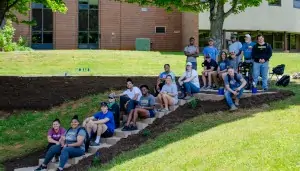
EPD 202 students sit on the steps they built leading to the Dr. Carolyn Thomas memorial bench during the three week May 2021 E-Term. Dr. Bob Pohlad photo.
During a three-week Environmental Planning and Development (EPD-202) Experiential Term (E-Term), led by Professor of Environmental Science Delia Heck and Professor Emeritus of Biology and Horticulture Bob Pohlad, seventeen Ferrum College students built, repaired, and beautified three sites on campus. In the process, they donated almost $5,600 in labor to the College, and one recent graduate even landed a job thanks to his involvement.
Alumnus Stephen Murphy completed the EPD-202 E-Term just days after earning his Bachelor of Science in environmental science this May 2021. He was then offered a job as a maintenance technician with Bedford Regional Water Authority. “My work with the E-Term and my previous job experience were key contributors for me to get the job,” Murphy explained. “During the interview, I was able to point to many examples of working with my group, and the collaboration between all of the E-Term groups. BRWA was impressed with my experience and that Ferrum has such a hands-on program.”
“This class was an excellent opportunity for our students to participate in experiential learning at its best,” said Heck. “They were able to learn about concepts of sustainability, engage in the work of repairing, building, and creating garden and riparian spaces, and develop a sense of pride in their efforts, their project, and the campus.”
For the first four days of the E-Term, the students assessed the sites: the memorial bench honoring Pohlad’s wife, the late Professor Emerita of Biology and Environmental Science Carolyn Thomas, and the riparian buffer zone and garden, all at Adams Lake; the conifer garden and the Jess Goode memorial garden, both in the campus community arboretum area; and the pond and stream feature, and wedding gazebo and garden, also in the arboretum area. Students thought about lighting and electricity aspects, hardscapes, soil types, and plant design.
The rest of the E-Term was spent in approximately 200 hours of field work. After the work was complete, the students presented to the community their processes, before and after photos, maintenance plans, next steps, and donation opportunities on Friday, May 21, 2021 in the Blue Ridge Mountain Room. A tour of the sites followed.
“After all these years of teaching, it still amazes me how well the students respond to the opportunities of experiential learning,” said Pohlad. “I saw the same enthusiasm and pride in their work this year as I saw over the last twenty. By doing these types of projects, each student leaves a legacy for future students to learn from and a place to honor the memories of those who have been an important part of our Ferrum community family. Their efforts and comments on work around Carolyn’s bench were especially touching to me.”
“This E-Term was lots of fun, lots of hard work, sweat and tears, but overall it was rewarding. We took a project that had been going on for over twenty years, worked on by many Ferrum students, faculty, and staff, and now we get to add our names to that legacy,” said rising senior Lauren Ries. “We walked into E-Term not knowing much about the projects but we walked away knowing more about landscaping, hard work, and ourselves. And we have tons of good memories. Hard work does pay off!”
“The students discovered and recovered hidden treasures, while creating their own,” said Heck. “They built memories, skills and connections that will last a lifetime.”
See photos from the EPD 202 E-Term here.
Learn more about Ferrum College E-Terms here.
Read the Roanoke Times’ coverage of the students’ presentation on May 21.
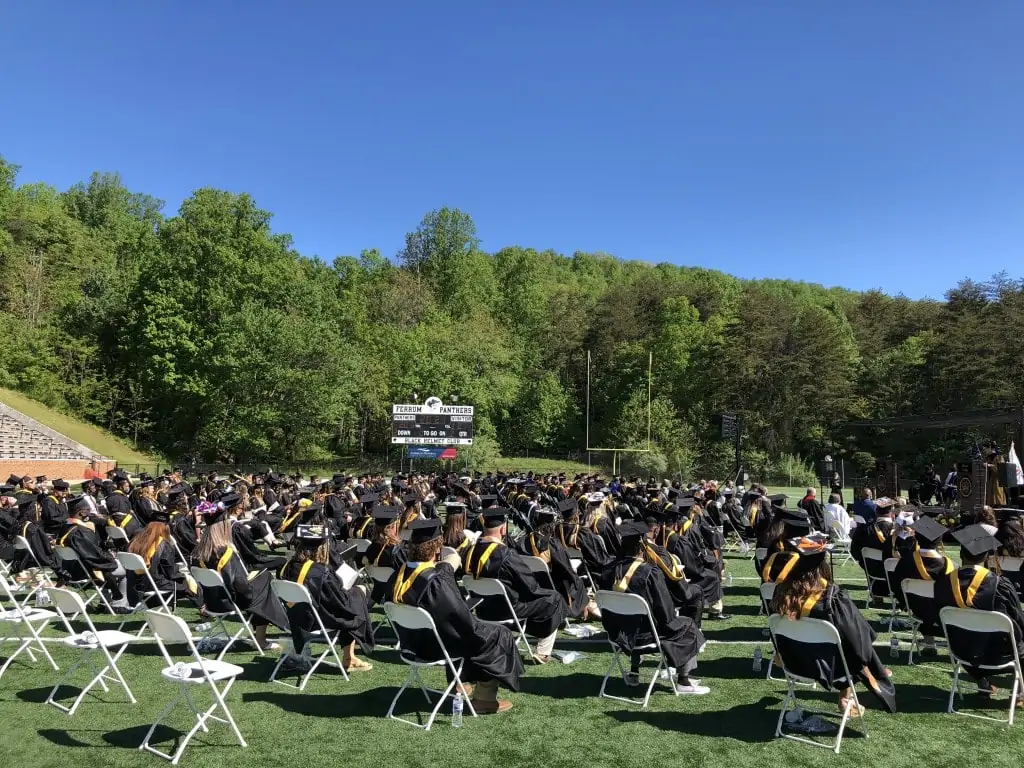
173 seniors from 12 different states earned degrees from Ferrum College during the 105th commencement ceremony on May 1, 2021.
5/1/2021
On Saturday, May 1, 2021, 173 Ferrum College graduates from 12 different states crossed the commencement stage at Adams Stadium during a socially distanced graduation ceremony.
The night before, on Friday, April 30 at 6 p.m., the College hosted an in-person ceremony, also at Adams Stadium, for the class of 2020. This ceremony followed last year’s commencement exercises, which were held virtually due to COVID-19. Friday’s keynote speaker was Virginia’s 2021 Teacher of the Year Anthony Swann. Class of 2020 graduates dressed in regalia and took photos with Ferrum College President David Johns. See photos from that event here.
The class of 2021’s commencement exercises began on Saturday at 10 a.m. and included award presentations under mild, sunny skies. The keynote speaker was New York Times bestselling author Jeff Selingo, who has written about higher education for more than two decades.
The ceremony began with the ringing of the historic Schoolfield Hall bell by President Johns and Provost and Vice President for Academic Affairs Aimé Sposato. Afterward, Sposato opened the commencement ceremony with a warm welcome to the graduates, family, friends, faculty, and staff. She noted that “each graduate has a special person or many people that have supported them throughout the past four years,” and thanked them for “sending care packages at just the right time, enduring virtual classes on Zoom, and sometimes getting late night phone calls accompanied by a few tears, doubts, and challenges.”
Following the invocation given by Reverend John Heck of Saint Peter’s-In-the-Mountains Episcopal Church, Johns took the podium to welcome the crowd and remind the graduates to thank their families for the support they received over their years at Ferrum.
Johns then commended the graduates on their dedication and progress. He instructed them to use what they had learned, saying “We are all given this one life; it is precious, a gift. I urge you to invest your life in healing the world. One of the hallmarks of a Ferrum College graduate is that we are committed to our motto – Not Self, But Others…Through your work, make the world healthier, happier, more free and just. Make it better.”
Ferrum College Board of Trustees Chair Scott Showalter ’73 and Alumni Association member Beth Simms ’09 each gave greetings on behalf of their respective boards. Afterward, Professor of Religion David Howell, who is retiring after 23 years of service in teaching, was recognized.
The presentation of awards followed. Professor of Environmental Science Delia Heck received the Exemplary Faculty Award, which recognizes a Ferrum College faculty member who embodies excellence in and commitment to teaching, demonstrates concern for student welfare in areas beyond academic studies, and is recognized as a competent scholar. Heck received numerous nominations for her service to the College and the greater community.
The Senior Academic Excellence Award was presented to Alexzondra Mattson ’21 of Virginia Beach, VA. This award is based on grades earned in all college courses by a full-time student, including those taken at Ferrum, as well as those received in transfer from other colleges or universities. Mattson maintained a 4.0 GPA and has earned a Bachelor of Science in pre-professional health sciences with a pre-med emphasis. She has been accepted to multiple Juris Doctor of Law programs and plans to make a decision soon.
Jack Sheehan ’21 of State College, PA, received the Arthur S. Owens Leadership Award, which is presented annually to the senior chosen by the faculty who best exemplifies the qualities of leadership, initiative, honor, and outstanding character. Recipients of this award must also hold an excellent academic record, have participated in extra-curricular activities, and shown creative initiative in making Ferrum College a better place to study, work, and live. His next step is to attend graduate school at Utah State University.
The Lillie Warwick Slaven Award was presented to Mia Brower ’21 from Kernersville, NC. The award is given to a student who exemplifies the ideals of the ministerial profession and is recognized as an outstanding student leader at Ferrum College.
Christian Haley ’21 of Boones Mill, VA, received the James T. Catlin Citizenship Award, which is given each year to the student who has best demonstrated qualities of citizenship and leadership.
Mattson was awarded one of two Algernon Sydney Sullivan Awards. The other went to Jacob Wilson ’21 from South Boston, VA. Recipients of this award are of noble character, spend their time bettering humankind, and apply fine spiritual qualities to their daily living. Wilson’s future plans involve teaching science in a secondary education setting.
Following the awards presentations, Selingo addressed the graduates, telling them to “get ready to navigate the ambiguity of life, heed the forces that take you in different, even opposite directions, and focus on what’s most meaningful to you…and in all your decisions, small and large…be patient, optimistic and yes, have a little faith.”
Student Government Association President Kintwon Pettiford ’22 of Hillsborough, NC then greeted the crowd and introduced Brower as the senior class speaker. She sent best wishes to the graduates and serenaded the crowd with a beautiful a cappella song.
Johns and Sposato conferred degrees on the eight first-ever Ferrum College graduate students receiving the degrees of Master of Science in Psychology and Education Specialist in Teacher Leadership and Coaching. The degrees were awarded by Dean of the School of Graduate and Online Education Studies Sandra Via.
Fifteen Boone Honors Program (BHP) graduates were also individually recognized and awarded a medallion by the program’s director, Professor of English Lana Whited. This year marks the highest number of honors medallion recipients, with a previous record of ten recipients in 2014. Read more about the fifteen BHP graduates here.
After the conferring and awarding of undergraduate degrees by Johns and Sposato, the crowd was asked to join in the singing of the College’s “Alma Mater.”
See photos of the 105th Ferrum College commencement ceremony here.
Davon “D” Robinson ’21 and Morganne Flinkstrom ’21 were featured in Roanoke Times and Franklin News-Post articles by Karen Dillon. Read about D here and about Morganne here.
Jack Sheehan ’21 received the President’s Cup. Read about him in this Franklin News-Post article.
 The Synergistic Classroom: Interdisciplinary Teaching in the Small College Setting was published in October 2020. The book of essays written by higher education professionals includes two chapters by Ferrum College professors, one about the Appalachian Cluster program for first-year students and one about the College’s multidisciplinary, team-taught honors seminars.
“Arts in the Laboratory: A Multidisciplinary Approach to Honors Education in a Small College Setting” was written by Professor of Psychology Sharon Stein and Professor of English & Director of the Boone Honors Program Lana Whited. Their seminar, Media and Violence*, explores depictions of violence in news and entertainment media, social scientists’ methods of studying the effects on society, and ways to address problems associated with media and violence.
“Experiential Learning in the Rural, Small College Setting: Creating an ‘Appalachian Cluster'” was written by Professor Emeritus of English Peter Crow; Professor of Environmental Science Delia Heck; Professor of English Tina Hanlon; Assistant Professor of Sociology Susan Mead; and Professor Emerita of Environmental Science and Biology Carolyn Thomas, who passed away in January 2020. Since 1999 they have all taught in the Appalachian Cluster, a learning community in which first-year students study modernization in Appalachia through interlinked courses in sociology, environmental science, and English.
Editors Corey Campion and Aaron Angello of Hood College designed The Synergistic Classroom to demonstrate innovations that expand the traditional boundaries of discipline-specific programs within the particular circumstances at small colleges. Blending disciplines within the curriculum can boost students’ engagement while preparing them for the kinds of critical thinking and teamwork required in the workplace.
Hanlon commented that “interdisciplinary collaboration has been the most rewarding part of my career at Ferrum since I first began team-teaching with Carolyn Thomas in the 1990s. I believe the Appalachian Cluster’s blend of introductory coursework and experiential learning while visiting communities in coal county now aligns well with President David Johns’ vision for enhancing the college’s work and outreach in our Blue Ridge environment.”
The Synergistic Classroom is available from Amazon and other booksellers, or visit Ferrum College’s library to check out a copy.
Learn more about Ferrum College’s efforts to provide interdisciplinary learning by following its Appalachian Cluster program on Facebook.
*The Ferrum College course catalog describes the Media and Violence course as “an interdisciplinary, team-taught, writing intensive study of the relationship between media and violence. The emphasis of the course will be on how violence is depicted in news and entertainment media, how media depictions of violence affect society, how social scientists study these effects, and how the problems associated with media and violence might be addressed.”
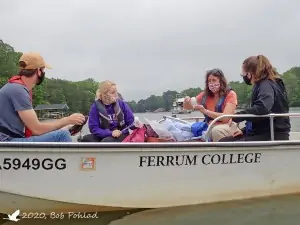
Ferrum College students work with Professor of Environmental Science Delia Heck during the 34th season of the Water Quality Monitoring Program. Left to right: Samuel Chappell; Michelle Musick; Delia Heck; and Chelsea Zizzi. Bob Pohlad photo.
Last week, the Smith Mountain Lake Association (SMLA) and Ferrum College Water Quality Monitoring Program began its 34th season. Since 1987, Ferrum College has worked with the SMLA to perform periodic testing of the lake water to help keep swimmers and boaters safer.
The Ferrum College portion of the team is made up of Program Director and Professor of Environmental Science and Natural Science Division Chair Delia Heck; Senior Scientist and Retired Professor Emeritus of Chemistry and Environmental Science David Johnson; Senior Scientist and Retired Professor Emeritus of Biology and Horticulture Bob Pohlad; Program Scientist and Assistant Professor of Biology and Horticulture Clay Britton; and Laboratory and Field Coordinator Carol Love.
Heck took over the director’s position after the January 2020 death of former Program Director and Retired Professor Emeritus of Environmental Science Carolyn Thomas. Thomas helped found the program.
This year, the team also consists fifty-four citizen scientists at Smith Mountain Lake who volunteer their time, and five paid Ferrum College student interns: senior Jacob Blaukovitch who is pursing a degree in chemistry, biology, and pre-professional health science (pre-med), with a one health minor; senior Lexi Davidson who is majoring in environmental science and minoring in biology; senior Michelle Musick who is earning an environmental science degree; senior Samuel Chappell who is majoring in environmental science and plans to graduate this December; and junior Chelsea Zizzi who is pursing a major in chemistry with a minor in English.
The Water Quality Monitoring Program is a labor of love for the Ferrum College team as it commands many hours during the summer months. “We test for bacteria every two weeks at fourteen sites with two stations at each site,” explained Heck. “We conduct depth profiles at five sites every two weeks. Our volunteers monitor and interns collect samples at fifty-six lake sites and twenty-two tributaries for trophic status monitoring.”
The team tests for e-Coli and other harmful bacteria. They also monitor algae biodiversity, watching for harmful algal blooms.
This year’s testing is even more complex than previous years due to COVID-19 restrictions. Heck said the team has developed safety protocols, including restricting interactions in the testing lab and with volunteers, implementing virtual training videos, rigid sanitizing, social distancing, wearing masks, and taking their temperatures daily. Each team member and volunteer also uses their own equipment including hand sanitizer, pens, personal flotation devices, and more.
Heck explained that water quality testing is not only important to keep swimmers and boaters safe, but is also an indicator of challenges in our environment. “Water is essential to our life on Earth. We face a changing climate and the interconnectedness between humans, health, and the environment are made clearer every day,” said Heck. “The project will continue to serve as an early warning sentinel as well as a model for how to to work collaboratively with our neighbors in living out our motto of Not Self, But Others. The partnership with the business sector, state government, and community exemplifies the very best Ferrum College has to offer our region.”
***
The 34th season of water quality monitoring has been dedicated to Carolyn Thomas, founding member of the program and beloved Ferrum College professor. The following statement was sent to this year’s citizen scientists in her honor:
“The Smith Mountain Lake Association and Ferrum College Water Quality Monitoring Program are dedicating the 2020 monitoring season to the memory of Dr. Carolyn Thomas, one of the founders of the program. Carolyn passed away in January after a courageous two-year battle with cancer. Carolyn’s passion for water quality was evident every time she ventured out on the lake. You can see that demonstrated in this interview with John Carlin from a few years ago.
“One of the traditions of the College’s sampling trips is to count great blue herons, Carolyn’s spirit animal. From now on when one is sighted we hope you will be reminded of Carolyn’s passion, her dedication to Smith Mountain Lake, and her love of citizen scientists like yourselves.”
Read more about the Smith Mountain Lake Association and Ferrum College Water Quality Monitoring Program here.
Ferrum College welcomes gifts made to the Carolyn Thomas Memorial Fund which supports students in the College’s Division of Natural Sciences. Please click here to make a gift in Thomas’s honor.
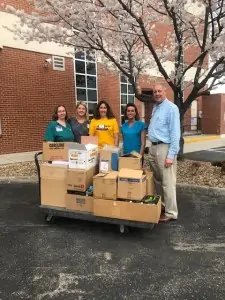
Pictured from left to right: CFMH Manager of Materials Laura Yerkey; Director of Nursing Tracy McCown; Ferrum College Natural Science Division Chair & Professor of Environmental Science Delia Heck; Health Professions Division Chair & Associate Professor of Biology Katie Goff; and CFMH Vice President & Administrator Carl Cline.
During the first week of Ferrum College’s distance learning program put in place to combat the spread of coronavirus (COVID-19), Adjunct Professor and former Dean of Natural Sciences and Mathematics Jinnie Garrett had an idea.
“Listening to the news reports of hospitals lacking personal protection equipment [PPE], I thought about all the supplies I know are sitting in academic and research labs around the country,” said Garrett. “I felt we should try to redirect those to the medical community while the supply chain is ramped up.”
Garrett contacted Ferrum College’s Natural Science Division Chair and Professor of Environmental Science Delia Heck, who put the idea into action. After Provost Aimé Sposato’s approval, a team of several faculty members, staff, and one student formed to gather PPE from various locations on Ferrum’s campus.
“[Laboratory Assistant] Eileen Maher and I went around Garber and collected [PPE],” said Heck. “It was like an Easter egg hunt going to various classrooms and labs to find ‘hidden’ locations. [Nursing Division Chair] Kim Brown also picked up supplies from our location at the Franklin Center in Rocky Mount. [Dean of Arts and Sciences and Professor of Chemistry] Jason Powell helped collect supplies from the labs.”
The team also included Health Professions Division Chair and Associate Professor of Biology Katie Goff; sophomore and recreation leadership major Benton Heck; and Lab Supervisor Carol Love.
The PPE that was gathered included 16,000 gloves, 450 protective surgical masks, 200 head coverings, 200 foot coverings, and 75 lab coats, and was delivered on Friday, March 20, to Carilion Franklin Memorial Hospital (CFMH) in Rocky Mount. The supplies were received by Carl Cline, vice president and administrator at CFMH; Tracy McCown, director of nursing; and Laura Yerkey, manager of materials.
“Carl Cline’s first response was that he was ‘flabbergasted’ by the offer of the PPE,” said Heck. “When we dropped it off we were only close together for about 30 seconds to take the picture so we were not putting each other in danger.”
CFMH will use the supplies within their system where the need is greatest during the COVID-19 pandemic.
“For Ferrum College, those resources were not going to their highest use-value. By donating them, they moved from shelves in empty buildings to meeting the needs of our community, exemplifying our motto of ‘Not Self, But Others’,” said Heck.
Read more about the donation in this Franklin News-Post article.
Read more about the School of Arts and Sciences here, and the School of Health Professions and Social Sciences here.
 Ferrum College Associate Professor of Environmental Science Delia Heck has accepted a three-year appointment to the Episcopal Church Task Force on Care of Creation and Environmental Racism.
The role of the task force is to recommend appropriate changes in federal, state or local law so that effective judicial remedies can be obtained to address governmental decisions with respect to land use, industrial, energy and transportation development, and application of environmental standards. The task force will accomplish this goal by studying disproportionate health or environmental impact on those living closest to the land in subsistence cultures, ethnic minorities or poor communities.
The group is made up of approximately twenty people from across The Episcopal Church which comprises the US, Taiwan, Haiti, Ecuador, Micronesia, Honduras, Columbia, Venezuela, Dominican Republic, Virgin Islands, and Puerto Rico.
“This appointment allows Ferrum College to have a front row seat in discussions about how our faith calls us to respond to issues of environmental justice and creation care in the political, social and economic arenas at the local and national levels. It demonstrates to our students that the journey begun with their Ferrum College education is not limited by our geography or size. Rather, their passions and drive, combined with the opportunities and experiences provided here, empower them to achieve their life’s dreams,” stated Dr. Heck.
This appointment follows Dr. Heck’s five trips to Haiti, the first taking place in June 2017, where she assessed the energy, economic and social justice needs of the country.
Watch Dr. Heck’s September seminar on her experiences in Haiti here. Also, read more about her work in Haiti in The Franklin News-Post article here.
About the photograph: Dr. Heck is meeting with members of St. Simon St. Jude in Duny, Haiti about their need for solar energy and how they might use the energy if a solar energy system was to be installed at the school. She was there with members of their videography team as well as members of the Haitian non-profit Voices & Actions which works to help women in a neighboring village by raising chickens, goats, pigs, and tilapia to sell at wholesale price in order for the women to sell the livestock in the market at retail price. The difference in the prices allows them to earn money to support their families by paying for school fees, food, clothing, etc.
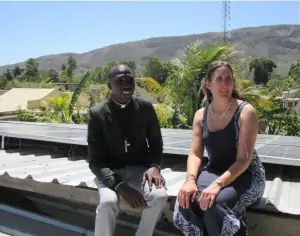
Dr. Delia Heck with Deacon Couloute Schneyder in Haiti.
Delia Heck, associate professor of environmental science, spent her sabbatical working with Haitian and American partners on solar energy projects in rural villages of Haiti. She was featured recently in Leigh Prom’s article in The Franklin News-Post. Read the article here.