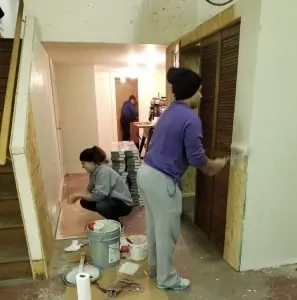
From November 2019: Ferrum College students and staff worked with Habitat for Humanity to renovate a local woman’s home. Pictured: staff member Leya Deickman ’19 (in purple), student Katrina Anderson (in grey), and Morgan Flinkstrom (in blue).
On October 17, 2020, homeowner Elaine Childress was welcomed into her newly renovated home in Rocky Mount, VA by board members from Habitat for Humanity Franklin County, which includes Ferrum College Dean of Students Nicole Lenez.

From November 2019, the Ferrum College women’s wrestling team (from top, L to R): Leya Deickman ’19; Morgan Flinkstrom; Andreia Langley; Katrina Anderson; homeowner Elaine Childress; Destiny Benjamin; Bailey Gilmore; Autumn Potkay ’20; coach Breonnah Neal; Caitlynn Richardson; Alisha Elizalde; & Gabriella Torres.
“It has been a privilege to serve with the members of the local Habitat for Humanity board as our community worked to give Elaine a gorgeous renovated home,” said Ferrum College Dean of Students Nicole Lenez. “Our students worked tirelessly for Elaine, truly living out our motto, ‘Not Self, But Others.'”
On every available Saturday over the last year, Ferrum College staff members and students, mainly the women’s wrestling team, worked with the local Habitat for Humanity chapter to ready Childress’s home after a renovation process that took two years in total. The house was gutted and then updated with siding, windows, decks, drywall, cabinets, and plumbing. Childress’s home also received a new electrical and ventilation system, and all new appliances.
“While volunteering for Habitat for Humanity, I understood that I was helping the community and Elaine,” said Ferrum College Residence Life Area Coordinator Leya Deickman ’19, who worked on Childress’s home as a College staff member (and is a former member of the Ferrum women’s wrestling team). “At that moment, the atmosphere felt cheerful and light, making our manual labor feel effortless. Although the laughs and memories were enough to instill this experience in my mind, the thank you note I received this past month reminded me of how impactful a simple volunteering experience could be for someone in need.”
Read more about this act of community service in this Franklin News-Post article.
Learn more about Ferrum College’s women’s wrestling team here.
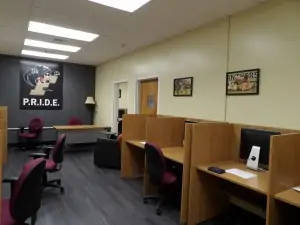
The newly renovated Carter Center for Academic Success includes a space for the PRIDE program, which focuses on academic & personal excellence for student-athletes. Donna Winge photo.
In the summer of 2020, the Carter Center for Academic Success, formerly known as the Academic Resources Center, received a facelift thanks to alumnus Maury Carter ’53 and his family.
“Seven siblings from my generation were Ferrum scholars,” said Carter. “Ferrum College provided more than a college textbook education. Taught there was an outstanding education, but equally important: compassion.”
“It is an exciting time for those of us who work in the Carter Center for Academic Success,” said Dean of Student Success and Assistant Professor David Wiggins. “Now the Carter Center is even more beautiful and functional. The students are thankful for a place where they can study individually or collectively, get peer-assisted tutoring, and learn new skills to help them with their academic success. We are very grateful to the Carter family for their gift.”
Located on the lower level of Ferrum College’s library, the newly renovated Carter Center is open 24 hours a day and boasts all new furniture, paint, carpeting, and ceiling tiles, plus a new camera and monitoring system. It provides resources and services to help students achieve their greatest academic potential, including one-on-one tutoring support, individual advising sessions, study groups for first-year students and military veterans, and support for students with learning differences.
Carter’s family was not financially secure during the College’s early days. “A family of ten. Mom and Dad and eight siblings,” remembered Carter. “A poor family a bit different from the students from more populated areas. Our parents could not have afforded to send any of us to college. Ferrum College made the dream of attending college possible for our family. The professors understood us and taught us well.”
After graduating from Ferrum, Carter went on to enjoy a successful career in real estate investment, primarily in Virginia and central Florida. Based in Orlando, Maury L. Carter & Associates has closed approximately $1,500,000,000 in real estate transactions on over 200,000 acres of land since the 1990s.
“The Carter family moved to Ferrum in 1914, one year after the College opened, and have been part of the Ferrum story ever since,” explained Vice President for Institutional Advancement Wilson Paine ’07. “This gift represents over one hundred years of support from the Carter family, and is a testament to their commitment to our students, the College, and the region.”
“I love the people there,” said Carter. “I love the town and Ferrum College. When I am on the College’s campus, I have a special feeling: a feeling of being at home.”
Learn more about the Carter Center for Academic Success by visiting here.
Read 1953 alumnus Maury Carter’s full thoughts below:
“‘Not Self, But Others.’ Ferrum College provided more than a college textbook education. Taught there was an outstanding education, but equally important: compassion. ‘Not Self, But Others.’
“There in them hills was a family called Carter. A family of ten. Mom and Dad and eight siblings. Seven siblings from my generation were Ferrum scholars. A poor family a bit different from the students from more populated areas. Our parents could not have afforded to send any of us to college. Ferrum College made the dream of attending college possible for our family. The professors understood us and taught us well.
“I believe my brother began attending Ferrum around 1920. Many of our family members have attended during our 100 year relationship with Ferrum College.
“On a personal note, I say that Ferrum College kept me out of tanks in Korea. I graduated in 1953 and entered the U.S. Army. After the rigorous basic training, we were being assigned locations, most to Korea. Out of a group of several hundred, I was selected to serve as a personnel specialist. This assignment taught me how to perform in an office environment and it prepared me for a position in aerospace.
“I love the people there. I love the mountains. I love the town and Ferrum College. When I am on the college campus, I have a special feeling: a feeling of being at home.”
For an in-depth account of Carter’s early life and achievements, please visit the Maury L. Carter & Associates, Inc. website.
 Due to COVID-19, the beloved annual “Empty Bowls” event was postponed from its usual spring date this year; however, dedicated community members are making sure the event still takes place, “COVID-style.”
The Ferrum College campus community and public are invited to enjoy a modified Empty Bowls event on Sunday, November 15, 2020 from 12 – 4 p.m. The event will be held in the Blue Ridge Mountain Room in the College’s Franklin Hall.
Attendees must pre-register for one of eight 20-minute time slots with each time slot offering a unique assortment of 100 handcrafted bowls, along with beautiful works of art. Each time slot will feature a different array of bowls so not time slot is better than any other. Twenty guests at a time will be allowed to view the bowls and artwork widely spaced within the room.
Tickets are free and there is no advance purchase required. Use this link to pre-register.
The bowls, handcrafted by Ferrum College students, community members, and professional potters from Floyd and Ferrum, VA, may be purchased for $15 each. The Blue Ridge Potters Guild and other local artists also generously donated 57 bowls and numerous original works of art, including a gorgeous large ceramic totem, paintings, pottery, jewelry, and more, which will be featured in a “set price” silent auction.
“I have been involved with Empty Bowls for many years now and am honored to be part of what is truly a community event,” said Nell Fredericksen, local potter and jeweler and co-coordinator of the event. “From the patrons that attend with warm hearts and open wallets, to the students making bowls, the support of Ferrum College, and the regional community of artists that are so generous with their time and talents – it is truly humbling. Through the efforts of everyone involved we have been able to support the food insecure children right here in our community for more than ten years.”
Due to COVID-19 restrictions, a meal will not be served and attendees must wear masks. Tables will be sanitized between each time slot and restocked with new bowls by National Honor Society volunteers Atticus Cooper and Lily Fredericksen.
All proceeds from the event support Panther Packs, a program at Ferrum Elementary School that sends qualifying children home for the weekend with backpacks stocked with nutritious, non-perishable food.
Following is list of original art donated to the event, and the artists who created it:
In addition to the bowls made by the Ferrum College ceramics classes, professional potters and community members handcrafted more than 200 bowls for the event. We are grateful for the talents of: Hona Knudsen, Steve Mitchell, Ron Sutterer, Wendy Werstlein, Josh Manning, Nell Fredericksen, Liz Cooper, Atticus Cooper, Neil Fredericksen, and Lily Fredericksen.
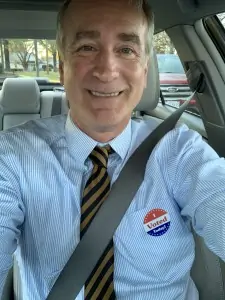 Panther Nation:
We are only a few days from the 2020 presidential election. The usual ramp-up to November has been intensified this year by the uncertainly of a global pandemic, a public health challenge that has remade our world in a matter of months. It also comes at a time when our country is thinking hard about its history and how to reckon with racism and social injustice. While every election is weighty and momentous, this one is especially so for these reasons, and more.
I am proud of how our college community works together through difficulties, how we celebrate together in moments of triumph, and how we treat each other with respect and grace when we disagree. This always serves us well, and it will do so in the weeks to come.
For some of you, this will be the first election in which you are eligible to vote. What a memorable day November 3 will be for you! Others of us have voted for decades and next Tuesday will be no less important. Each of us goes to the polls with a commitment to the future and with a steady belief that the messiness of democracy is worth it. At the very heart of being an American is unwavering optimism that, as Harry Emerson Fosdick once remarked, “… there are extraordinary possibilities in ordinary people.”
I urge you, if you are eligible and registered, to please vote. It is one small way we participate in self-governance, and one huge expression of gratitude for the women and men who have sacrificed their lives over the centuries to ensure we enjoy this freedom.
I urge you also to be kind to one another, to treat each other on Wednesday, November 4 the way you do today. As Lincoln stated in his second inaugural address: “with malice toward none; with charity for all.”
Inevitably, some will be more enthusiastic and hopeful about the elections’ results than others. But whether on Wednesday we celebrate or whether we are disappointed, we remain family and we need each other. Every day, this community embodies an array of ideas of how to build the future, of how to achieve “a more perfect union;” nevertheless, we are joined together by a fundamental belief that our lives are better, fuller, and richer, when we live them together, and when we live them for each other.
With Panther (and American!) pride,
David L. Johns, Ph.D.
President
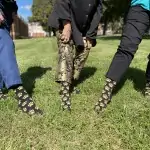 Ferrum College officially launched “Socktober” on October 1, 2020. The campaign will run through October 31.
The campaign asks students, alumni, faculty, staff, and friends of the College to pledge to give a recurring monthly gift of at least $19.13, which honors the institution’s founding year. In return, donors will receive a complimentary pair of custom designed Ferrum College socks which are available only through this campaign and cannot be purchased anywhere else, including in the campus store.
All monthly gifts of $19.13 are eligible, but the College notes the greater the gift, the greater the impact on Ferrum students and the campus.
Recurring gifts will go to the Ferrum Fund, which is made up of unrestricted dollars and helps provide key resources for student scholarships, academic programs, athletics, and more. Learn more about the Ferrum Fund here.
Donors are also asked to take a photo of themselves in their socks and post it to social media, tagging #FerrumCollege and #RockTheSocks.
Learn more and sign up to give a monthly gift at www.ferrum.edu/rockthesocks.
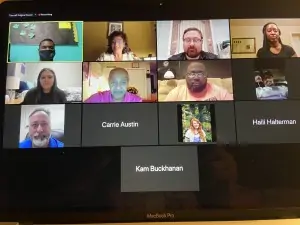
On September 30, SGA held a Zoom session with Aladdin Food Services, which provides dining options on campus.
In this semi-virtual world in which colleges are presently living to keep COVID-19 numbers at bay, Ferrum College’s Student Government Association (SGA) is striving to keep campus members informed.
Beginning in September, SGA coordinated town hall Zoom meetings during which students, faculty, and staff are invited to log on to hear from various departments on campus and ask questions.
“We want to bridge the gap between students, faculty, and staff. By hosting Zoom meetings, we are doing just that,” said SGA President Kintwon Pettiford ’22. “We want students to know their voices are being heard and that they are able to make changes, if needed.”
On September 23, 2020, SGA held its first town hall Zoom meeting, hosting Dean of Students and Title IX and Pandemic Coordinator Nicole Lenez. During the session, Lenez answered questions and outlined the steps the College is taking to continuing keeping positive COVID-19 cases low on campus. On September 30, SGA held another successful town hall Zoom session, this time with Aladdin Food Services, which provides dining options on campus.
The meetings will be held once a month, allowing SGA time to canvas the student body for topics that students want to learn more about.
Pettiford urges campus members to stay tuned. Upcoming Zoom meeting topics include a session on activities with Director of Student Activities Justin Muse ’05 and a session called “What’s Next” with President David Johns and Provost and Vice President for Academic Affairs Aimé Sposato.
Meet the 2020-21 SGA cabinet members here.
 Last month, Ferrum College’s Nursing Division Chair Kimberly Brown was selected to share her presentation, The Impact of Academic Nurse Leaders’ Toxic Behaviors on Faculty, during this fall’s Virginia Nurses Association’s virtual conference. The conference, held September 23-24, 2020, carried the theme, Ending Incivility, Bullying, & Workplace Violence.
This was Brown’s first time as a presenter at the VNA conference; however, she has attended many times in years past. She described the conference as a “robust time of growing the knowledge of nursing – each event has a theme and content experts facilitate presentations and discussion around topics that are presented.”
Brown’s presentation focused on incivility in the workplace. “As it relates to nursing or healthcare, peer to peer incivility and student to faculty incivility is well documented in scholarly literature,” she said.
“Incivility and bullying in leadership ranks is an area where there is a gap in the information. The research team identified this gap, and based on personal past experience at various institutions, we agreed that toxic or uncivil behavior among academic nurse leaders is a phenomenon that should be studied for further understanding,” Brown explained.
Because of COVID-19, the 2020 conference was held virtually and all presentations were pre-recorded.
“‘Eating our young’ is unfortunately something that nursing has been known for,” said Brown. “As an academic nursing leader, it is my goal to nurture not only students but peers and faculty alike such that they embrace growth, feel valued, and flourish into all they can be in whatever role they are in.”
Learn more about the fall 2020 VNA Conference and its presenters here.
Click here to learn more about Dr. Brown.
Learn more about Ferrum College’s nursing program here.
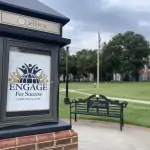 Signs bearing the phrase “Engage for Success” are popping up all over Ferrum College’s campus this fall. These three words sum up the institution’s theme for the new quality enhancement plan, or QEP, which will be in effect for about the next decade.
This QEP topic was chosen after a yearlong process which included focus groups and surveys from students, faculty, coaches, and administrators. The general consensus was that campus members, particularly students, wanted to increase academic engagement on Ferrum’s campus.
“We believe that Ferrum students achieve more when they are more active in their classrooms, on the playing field, in worship, or other activities,” said Associate Professor of Political Science Ed Hally, who is leading the new QEP initiative. “Not only that, but engaged students adjust to college life better and tend to feel a greater connection to their fellow students, Ferrum faculty and staff, and the College as a whole.”
“Engage for Success” includes six subcategories of engagement:
Once the topic has been approved by the Southern Association of Colleges and Schools Commission on Colleges (SACSCOC), “this upcoming year – year 0 – will be mostly about getting a snapshot of how engaged students already are in these areas,” explained Hally. “We’ll use this year to establish a baseline and then try to beat that baseline in future years.”
Hally and the QEP team plan to utilize an online app called “Presence” to monitor the program’s progress. With the app, event coordinators will be able to list their events, tagging up to two types of student engagement. Students will also be able to easily access an events calendar to attend gatherings.
Fall 2021’s goals include ramping up student engagement as much as possible with encouragement from student leaders, faculty, and staff; and prize giveaways rewarding the most engaged students at Ferrum.
 (August 26, 2020) As students move back to college this month, the usual excitement and bittersweet goodbyes are being seasoned with apprehension and whispered prayers.
None of us are naive, we know this is going to be challenging. We know we must take extra precautions. We know everything could turn on a dime at any moment, and we all know it’s not 2019 any longer!
Every one of our schools has developed contingency plans and scenarios ranging from the likely to the apocalyptic. We are well aware that as Theodore Roosevelt once remarked: “Nothing in the world is worth having or worth doing unless it means effort.” Returning to college this fall is going to require effort because, at the end of the day, it is worth it.
And it is worth it for at least three reasons: students, colleges themselves, and the communities in which our colleges are located.
First, no one stands to lose more than students if our colleges do not return to campus activity.
While colleges learned how to serve their students in unfamiliar yet effective ways, and while faculty performed the Herculean task of transitioning to remote instruction, all this has taken a toll that is unsustainable and undesirable.
One third of students in Virginia attend an independent college like Ferrum College. Although many news articles focus on flagship public universities or elite private colleges, most independent colleges have modest resources and depend mightily on tuition dollars and philanthropy.
We enroll a greater percentage of minority students, first generation college students, and students from families with economic need than do the others. This is not a criticism, but it is a fact. Vulnerable women and men are left in the lurch when our campuses are shuttered. Additionally, rebuilding our economy after COVID-19 will require that students continue developing skills of resilience, critical and imaginative thinking, and civic engagement.
Second, the return must work for the sake of colleges themselves.
Colleges are businesses that have a fundamental social mission. During the pandemic, a few have written that any college unable to survive a couple semesters without students on campus should close. This is the most foolish and ill-informed statement anyone could make. No one would suggest that a grocery chain or a clothing manufacturer was irresponsible for needing to sell groceries or clothes to continue operating. That’s what they do. Likewise colleges and universities.
The economic havoc brought about by COVID-19 will destroy many small businesses, and some of these casualties will be colleges. Losing them will cause irreparable harm to freedom and opportunity. Thus, the return to college must work in order to preserve these champions of learning, support, research and culture.
When we reach the other side of this pandemic, we will need an educated and prepared workforce to help rebuild our country and position us for tomorrow. And to prepare these women and men, we need healthy colleges.
Third, the return must work for the communities where our colleges are located.
A college in any town is an economic boon. Many of our independent colleges are located in small towns where they are a major employer. Even a college the size of Ferrum has a $100 million impact in our region. The college helps to sustain business and livelihoods in this area, as do the others in their hometowns.
It is understandable that communities are apprehensive about the return. However, the long-term damage to our communities and to thousands of families will be extensive unless we find a way to make this work.
Let’s face it: unless we are willing to remain in absolute home lockdown–every one of us–for the next 12 months or longer, then we are acknowledging there are other social and economic concerns to be balanced in addition to caring for our health and slowing the virus. We have an obligation to sustain our communities and assure a stable economy.
So, while we know this will be a challenging semester requiring effort from everyone, it will be worth it on several fronts–for our students, our colleges and our communities. The only way for us not to be defeated by COVID-19 is to live, to thrive and to stay focused on things that matter. We must be cautious and conscientious, of course, but we cannot lock ourselves away cowering in fear. This pandemic will destroy us, but only if we permit it.
Hard does not mean impossible.
This column by President David Johns appeared in The Roanoke Times and The Franklin News-Post. President Johns may be reached at president@ferrum.edu.
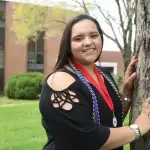 As a Sam Houston State University graduate student earning a Master of Public Administration with a concentration in emergency management and coordination, alumna Victoria Miller ’18 is also beginning a new journey as an intern in NASA’s Pathways Program.
The Pathways Program provides an opportunity for current students to work, explore a career, and further NASA’s goals and mission, all while continuing their education. Learn more about the program here.
On August 17, 2020, Miller began working in the Office of Procurement for Operations Support at NASA-Johnson Space Center in Houston, TX. Her duties include covering contracts, task orders, and proposals, and analyzing orders for several different departments including flight operations, safety missions, SpaceX, and Boeing.
“My first week at NASA has been unique for sure,” said Miller. “The whole agency is facing new obstacles with everyone being virtual. It’s been fun, busy, challenging, exciting, and eye opening for me. I am constantly learning new material and getting to build new relationships, and I’m very excited to see what the future holds for me at NASA.”
Miller is a 2018 Ferrum College magna cum laude graduate. She received her undergraduate degree in political science with a minor in business administration. During her time at Ferrum, she was a member of the women’s wrestling team, the women’s tennis team, and the Boone Honors Program.
Miller said her experiences at Ferrum College had a lasting impact on her. “I went on an E-term to Mexico City,” she said. “The greatest memory I have from that trip was when we visited an orphanage and we taught the children there how to do different play dough art projects with our cameras. The children were so sweet, kind, and happy to have us there. They danced and sang for us. I remember how happy they were even though they have a difficult life. It was the best experience I have ever had.”
“There are so many things to love about Ferrum,” Miller continued. “Being 1,200 miles away from home, I could always count on my Ferrum friends and family to be there for me. Ferrum gave me experiences I never dreamed of, and the family and friends I’ve always wished for.”
Now, Miller is back in her hometown of League City, TX, just a few minutes from her Pathways internship in Houston. She lives there with her husband Hunter, and their boxer terrier mix Noel. In her free time, Miller enjoys weight lifting, painting, reading books, planting succulents, and playing board games and corn hole with her family and friends.
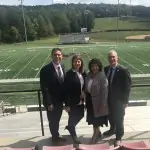
UPIKE President Burton Webb, UPIKE Provost Lori Werth, Ferrum College Provost & Vice President for Academic Affairs Aimé Sposato, and Ferrum College President David Johns.
In July 2020, Ferrum College and the University of Pikeville (UPIKE) entered into an agreement to provide access to a Master of Social Work degree to Ferrum students.
“Those who make social work a career are special individuals, and knowing that our partnership will play a part in helping those students further their education with a graduate degree is very fulfilling,” said Ferrum College President David Johns.
This agreement is the second in Ferrum and UPIKE’s history together. The two institutions began their initial partnership in September 2019, when UPIKE pledged to reserve one seat each academic year in its Doctor of Optometry program for a Ferrum College student who meets all early admissions criteria.
For UPIKE’s Master of Social Work program, the university has again agreed to reserve one seat each academic year for a Ferrum College student who meets all early admissions requirements. UPIKE’s offer of admission is open to Ferrum students who have earned a Bachelor of Social Work, as well as those who have earned a bachelor’s degree in any other field of study, provided that those students have 21 credit hours in liberal studies.
“We are fortunate to have such great partners at the University of Pikeville,” Johns continued, “and we are pleased to collaborate with them again to provide new opportunities for our students. This pandemic has highlighted the important role social workers play in holding together the fabric of our society. I am grateful we will be working together to prepare our students for this critical career.”
“Ferrum College and the University of Pikeville are committed to finding additional ways to grow our partnership,” said Provost and Vice President for Academic Affairs Aimé Sposato. “Our memorandum of understanding regarding the Master of Social Work program at UPIKE will build yet another pathway for Ferrum College students to excel in their purpose.”
UPIKE’s Master of Social Work program is delivered online with courses offered year-round so that students may continue to work while obtaining their degree. The masters program offers a 30-hour advanced standing option for students who hold a bachelor’s degree in social work, and a 60-hour program for students who have a bachelor’s degree in a field other than social work, or who completed a social work degree in a non-accredited program. All accepted students are required to have at least a 3.0 GPA.
“Our agreement with the University of Pikeville will help Ferrum College graduates press forward in their education to live out our College’s motto, Not Self, But Others,” said Dean of Health Professions and Social Sciences Angie Dahl. “There is a great need for social workers across our region, so we are thrilled to continue building our strong partnership with UPIKE to make these opportunities available to our students.”
“We are very excited by this opportunity to formally connect with UPIKE’s Master of Social Work program,” said Associate Professor of Social Work Martha Haley-Bowling. “Students will have the opportunity to attend a top notch MSW program to further their educational and career goals.”
Learn more about Ferrum College’s social work program here.
Learn more about UPIKE’s Master of Social Work program here.
(August 5, 2020) After COVID . . . What?
What awaits on the other side of COVID-19? We have all thought about it, whether out of weariness or a need to plan ahead. But, while we have imagined it, an answer is nowhere in sight.
It seems premature to ask the question because no one knows where we are on the timeline of the pandemic. If we have a vaccine in early 2021, five or six months from now, then at best we are only half way through. But are we closer to the end of the middle, or God forbid, the beginning? Regardless, it is worth thinking about what lies beyond COVID-19 since, sooner or later, we will be there.
I have two concerns and two hopes as I think about our Post-COVID future.
My first concern is that social distancing will lead to social isolation.
We need to maintain physical distance to slow the spread of the virus. In order to do so, many businesses have sent employees home, schools have transitioned to online instruction, and communities have postponed or canceled events that often bring us together.
But distance leads to isolation when we forget the simple acts of common life. We have learned over the last few months that many of our regular activities and meetings can be conducted virtually. But how can we assure that community life thrives, and how can we be sure we are building a Post-pandemic life worth living?
My second concern is that by the time we reach the other side of COVID-19, we will have become an America fractured beyond recognition. Between daily gaslighting and politicizing this pandemic, a wedge is being driven into an already cavernous divide. The wedge is between two impulses at the heart of the American psyche – compassion for the Other, and individual liberty.
At our best, Americans are generous people. We are present during crises at home and abroad, and we have given much for the sake of others. Yet, Americans can be stubbornly independent, regarding liberty as a license to do anything we want. Generally, we balance both impulses according to circumstance and need, but this wedge causes extremism leaving little room for compromise or restraint.
Yet, in spite of these concerns, I have two hopes.
First, many things that were important a half year ago, seem less so today. The pandemic has kept us close to home, close to family, and close to those things as the center of our lives. Some of what consumed our time and resources, have faded into the background.
It can takes years to achieve the pared down lifestyle thrust upon us in just a few months. While it was uninvited and threw us off balance, we are living reprioritized lives, a little more grounded, and a lot less distracted.
Thus, my first hope is that we maintain this hard eared perspective; if we can, then we will have gained something meaningful in exchange for the havoc this pandemic has brought us.
My second hope is that COVID-19 will renew our commitment to each other and to the common good.
We have been reminded that airborne pathogens do not seek permission before crossing barriers we erect. We have learned that reckless personal conduct causes lasting damage. And, we are learning that simple gestures, like wearing a mask in public, saves lives and slows a virus.
Much of what makes our communities livable, from good roads, to schools and parks, to clean water, to healthcare are goods that benefit us all. Our wellbeing is wrapped up together, so if we want a good life for ourselves after COVID-19, we need to invest in each other. Our lives may run in different directions, but we all breathe the same air.
I’m not sure what lies on the other side of COVID-19, but whatever it is, it will not be something that simply happens to us. That’s not the way the future works. The future is something we create through our passion, our imagination, and our commitment.
So, while it may seem a little early to speculate about what comes after COVID-19, we have work to do now. Allowing isolation and division to flourish will result in a future worse than any pandemic; however, if we stay grounded in what is important and lasting, and if we focus on the goods common to us all, we will build a Post-COVID future worth living.
This column by President David Johns appeared in The Roanoke Times and The Franklin News-Post. President Johns may be reached at president@ferrum.edu.