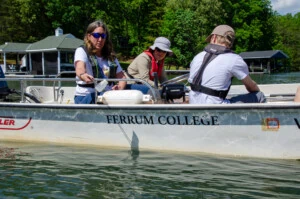
 The Smith Mountain Lake Volunteer Water Quality Monitoring Program (SMLWQMP), administered by scientists from Ferrum College in collaboration with the Smith Mountain Lake Association (SMLA), is celebrating its thirty-sixth anniversary this year. Initiated in 1987, the program has functioned each year to monitor the water quality in Smith Mountain Lake and to encourage active participation of the lake community in protecting this resource.
Each summer, Ferrum College faculty, students, and SMLA representatives and volunteers monitor the lake water for nutrients, bacteria, and algal blooms. Stakeholders and local health departments use collected data to inform the community of any concerns.
Ferrum College Professor of Environmental Science and Smith Mountain Lake Water Quality Monitoring Program Director Delia Heck has been an integral part of the program for 17 years. “For me, the SMLWQMP is an excellent example of the synergy possible between academia, citizen scientists, government agencies, industry, and regional advocacy groups to ensure the viability of our water resources. Ferrum College faculty, staff, and students work closely with the Smith Mountain Lake Association and its members on a weekly basis to run the program. This work wouldn’t be possible without the support of Appalachian Power Company, Bedford County Regional Water Authority, Smith Mountain Lake Association, Virginia Department of Environmental Quality, and Western Virginia Water Authority.”
“I am the intern responsible for the total phosphorus portion of the water quality project,” said student intern and Ferrum College senior Emma Brubaker. “I love this project. Working under and learning from these professors has already been one of the best experiences I’ve had. I can’t wait to see everything I learn this summer while doing something I love.”
Ferrum College senior and student intern Shane Hernandez’s family visited Smith Mountain Lake long before he was ever born. He has many wonderful memories of the lake and feels great to be able to do something for the lake and the community. “My job is to collect, analyze, and identify algae samples. While it is not the most entertaining job, I still find a great amount of satisfaction knowing that I am helping the community. It is awesome to learn more about the lake I have spent most of my life on.”
“I’m one of the main leaders on bacteria sampling and analysis,” said student intern and Ferrum College junior René Settle. “I am very excited about what I’ve learned here so far. I especially love being out on the lake and on the boat, even if I do get a sunburn. It’s so fun to be able to see the data come in and understand the reason behind the numbers.”
Faculty Emeritus of Biology and Agriculture Bob Pohlad has been involved in the program from the early days as a support person. He became directly involved in harmful algal bloom and invasive weed identification in 2007 as the need arose for expertise in this area. Pohlad was married to the late Ferrum College Faculty Emerita of Environmental Science and Smith Mountain Lake advocate Carolyn Thomas. Thomas, who passed away in 2020, was one of the original scientists, together with Ferrum College Faculty Emeritus David Johnson, who founded the Smith Mountain Lake Association’s Water Quality Monitoring Program. Involved in the program from the beginning until her death, Thomas worked closely with Ferrum College students analyzing water samples.
Pohlad noted he was fortunate to be able to work side-by-side for over forty years with Thomas at Ferrum College doing what they both loved, teaching and sharing knowledge and passion for nature with others. “Carolyn found an ideal place to study lakes when we came to Ferrum in 1978 where we lived between Smith Mountain Lake on one end of Franklin County and Philpott Lake on the other. Her passion for sharing this interest with others manifested itself in her teaching and outreach to community groups. She always was willing to share her research results at local, regional, and national meetings to promote stewardship and care of the environment. Her passion for caring for the environment was her driving force right up until she passed away in 2020.”
Ferrum College recently announced the endowment of the Carolyn L. Thomas Memorial Fund, which will provide critical support to the College’s natural science programs. Established in memory of Thomas, the fund will primarily support experiential learning projects for students in environmental science, agriculture, and biology. Pohlad stated, “The endowed Memorial Fund in her name supports the experiential learning that she felt so passionate about both through class trips we took and students who worked with us over the years on the Smith Mountain Lake Water Quality Project. I am so appreciative of all of those who donated to honor her and her legacy of helping others. She truly was a Not Self, But Others person throughout her life.”
To view additional photos of the Smith Mountain Lake Volunteer Water Quality Monitoring Program, click here.
To learn more about the Carolyn L. Thomas Memorial Fund, click here.
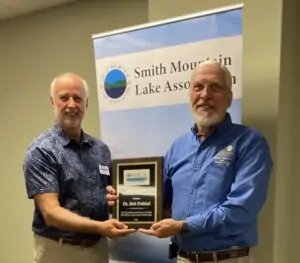
SMLA President John Rupnik presents the Melvin Johnson Award to Dr. Bob Pohlad.
10/22/2021
During their monthly meeting on Tuesday, October 19, the Smith Mountain Lake Association (SMLA) bestowed the 2021 Melvin S. Johnston Citizen Volunteer Award upon Ferrum College Professor Emeritus Bob Pohlad.
The annual award, named for philanthropist and SMLA founder Melvin Johnston, is given to those who have had a great impact on the Smith Mountain Lake area during the year, or over an extended period of time. SMLA board member Lori Smith, who also served as SMLA president from 2017-19, was Pohlad’s counterpart in receiving the award.
Pohlad has served as senior scientist for the Water Quality Program (WQP) on Smith Mountain Lake, which was founded 35 years ago by Pohlad’s late wife, Dr. Carolyn Thomas, and Dr. Dave Johnson. Both Thomas and Johnson taught at Ferrum College with Pohlad.
“I am very honored to be given this award by the SMLA, and to be a part of the Smith Mountain Lake Water Quality Program and the Master Naturalist Program,” said Pohlad. “These programs help people engage in citizen science that enhances everyone’s knowledge of our valuable local resources to benefit us all.”
In his role as senior scientist, Pohlad coordinated the recent development and implementation of SMLA’s new algae reporting tool, which has since been integrated into the Virginia Department of Health reporting system.
Pohlad also helps to train volunteers of the Blue Ridge Foothills and Lakes chapter of the Virginia Master Naturalists. These volunteers take on active projects at Smith Mountain Lake, such as monitoring waters and streams, invasive species control, and buffer landscaping. Pohlad designed curriculum for training and taught classes both in person and over Zoom during the COVID-19 public health crisis.
“The awards committee and the SMLA Board felt strongly that Dr. Pohlad’s long record of service to the WQP was due appropriate recognition, as was his service in preparing so many citizen scientists over the years,” said SMLA board member Geoffrey Orth, who also serves as the coordinator for Save our Streams. “He is truly, as the citation of the award indicates, the institutional memory of the WQP and a go-to person for some of our knottiest problems. It is hard to imagine how the WQP and its volunteer base would have reached its current level of expertise without him.”
Learn more in these articles by The Franklin News-Post and The Laker Weekly.
Learn more about Ferrum College’s role in the Water Quality Program.