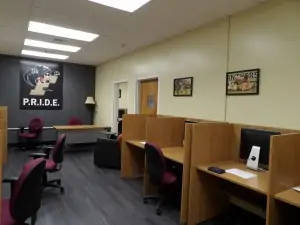
The newly renovated Carter Center for Academic Success includes a space for the PRIDE program, which focuses on academic & personal excellence for student-athletes. Donna Winge photo.
In the summer of 2020, the Carter Center for Academic Success, formerly known as the Academic Resources Center, received a facelift thanks to alumnus Maury Carter ’53 and his family.
“Seven siblings from my generation were Ferrum scholars,” said Carter. “Ferrum College provided more than a college textbook education. Taught there was an outstanding education, but equally important: compassion.”
“It is an exciting time for those of us who work in the Carter Center for Academic Success,” said Dean of Student Success and Assistant Professor David Wiggins. “Now the Carter Center is even more beautiful and functional. The students are thankful for a place where they can study individually or collectively, get peer-assisted tutoring, and learn new skills to help them with their academic success. We are very grateful to the Carter family for their gift.”
Located on the lower level of Ferrum College’s library, the newly renovated Carter Center is open 24 hours a day and boasts all new furniture, paint, carpeting, and ceiling tiles, plus a new camera and monitoring system. It provides resources and services to help students achieve their greatest academic potential, including one-on-one tutoring support, individual advising sessions, study groups for first-year students and military veterans, and support for students with learning differences.
Carter’s family was not financially secure during the College’s early days. “A family of ten. Mom and Dad and eight siblings,” remembered Carter. “A poor family a bit different from the students from more populated areas. Our parents could not have afforded to send any of us to college. Ferrum College made the dream of attending college possible for our family. The professors understood us and taught us well.”
After graduating from Ferrum, Carter went on to enjoy a successful career in real estate investment, primarily in Virginia and central Florida. Based in Orlando, Maury L. Carter & Associates has closed approximately $1,500,000,000 in real estate transactions on over 200,000 acres of land since the 1990s.
“The Carter family moved to Ferrum in 1914, one year after the College opened, and have been part of the Ferrum story ever since,” explained Vice President for Institutional Advancement Wilson Paine ’07. “This gift represents over one hundred years of support from the Carter family, and is a testament to their commitment to our students, the College, and the region.”
“I love the people there,” said Carter. “I love the town and Ferrum College. When I am on the College’s campus, I have a special feeling: a feeling of being at home.”
Learn more about the Carter Center for Academic Success by visiting here.
Read 1953 alumnus Maury Carter’s full thoughts below:
“‘Not Self, But Others.’ Ferrum College provided more than a college textbook education. Taught there was an outstanding education, but equally important: compassion. ‘Not Self, But Others.’
“There in them hills was a family called Carter. A family of ten. Mom and Dad and eight siblings. Seven siblings from my generation were Ferrum scholars. A poor family a bit different from the students from more populated areas. Our parents could not have afforded to send any of us to college. Ferrum College made the dream of attending college possible for our family. The professors understood us and taught us well.
“I believe my brother began attending Ferrum around 1920. Many of our family members have attended during our 100 year relationship with Ferrum College.
“On a personal note, I say that Ferrum College kept me out of tanks in Korea. I graduated in 1953 and entered the U.S. Army. After the rigorous basic training, we were being assigned locations, most to Korea. Out of a group of several hundred, I was selected to serve as a personnel specialist. This assignment taught me how to perform in an office environment and it prepared me for a position in aerospace.
“I love the people there. I love the mountains. I love the town and Ferrum College. When I am on the college campus, I have a special feeling: a feeling of being at home.”
For an in-depth account of Carter’s early life and achievements, please visit the Maury L. Carter & Associates, Inc. website.
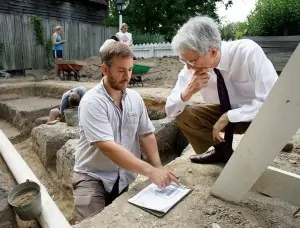
Dr. Ed Chappell, on right, at the Public Armoury in Colonial Williamsburg, 2010. Photo courtesy of Colonial Williamsburg Foundation.
On Saturday, July 25, 2020, architectural historian and Ferrum Junior College alumnus Edward A. Chappell, Jr. passed away at the age of 71. He leaves behind his wife Susan.
Chappell was born in Farmville, VA on October 16, 1948. After graduating from then-Ferrum Junior College in 1969, Chappell earned a bachelors degree in history from the College of William and Mary in 1972, and then received his graduate degree from the School of Architecture at the University of Virginia.
As a young architectural historian, Chappell traveled through Virginia and Kentucky, mapping and recording historical sites for the Virginia Landmarks Commission and Virginia’s Department of Historic Resources. In 1980, he was hired as the Shirley and Richard Roberts director of Architectural Research and Archaeology at Colonial Williamsburg. He and other historians added numerous buildings including Charlton’s Coffeehouse, the Public Armoury, and the Market House.
When Chappell retired in 2016 after 36 years of service, he held an endowed chair at the Architectural Research Department and continued to share his expertise with other historical preservationists at Monticello, Mount Vernon, Prestwood, Drayton Hall, the Historic Charleston Foundation, and Historic Annapolis.
He was a world traveler, visiting countries like Russia, the Ukraine, the Czech Republic, Bali, China, Europe, and more. On his visits, he made drawings and notes of buildings and later donated them to the Virginia Historical Society. He imparted architectural knowledge to review boards for colonial Williamsburg as well as the College of William and Mary, eventually receiving the highest stewardship award as a token of the college’s gratitude.
Former Ferrum College Board of Trustees Chair Bob Todd offered insight on Chappell’s informed yet unassuming nature: “If you met Ed, you would not assume he was an internationally known expert on architectural history. He was soft spoken and humble and never seemed to seek the spotlight. However, when engaging him about his area of expertise, one immediately recognized his mental energy and that he was someone with highly special knowledge and experience. He also possessed a wry sense of humor and an appreciation for life and inquiry. His passing will leave a huge void here in Williamsburg and beyond. We lose a lifetime of stored knowledge, not to mention a most wonderful, down-to-earth person.”
Read Chappell’s obituary in the Richmond Times-Dispatch, here.
 (June 24, 2020) No words, no official statements, no acts of contrition are sufficient in this moment of our history, because nothing can erase generations of pain and oppression. Nothing we can do will ever undo what has been done.
I am heartbroken by the violence of injustice that results in senseless death decimating families and dashing the hope of mothers who must bury their children.
And I am heartbroken by the violence that erupts when injustice persists and those crushed by its weight cry out, “enough.”
We pass through cycles, it seems, from complacency to consciousness to outrage to acceptance to complacency once again. I want to believe that at some point, in one of the passes through the cycle, we will break free and live more enlightened lives. However, I am afraid that this cycle is a slow spiral with occasional plateaus of improvement.
Perhaps our work is to hasten the movement of the cycle, speed it up and advance us more steadily toward a place of justice and being “one nation under God.”
Without a doubt, colleges and universities have contributed to inequity and injustice through the years, keeping certain groups at the top and limiting opportunity for others. Privileged faculty teaching the children of privilege has assured the continuation of class stratification.
The recent admissions scandals unveiled just how much privilege and legacy stay alive at the hands of an unscrupulous few–an entire shadow industry that profits on keeping the poor and less well connected from advancing.
However, while being far from perfect, our colleges are one of the few places left in society that intentionally bring together people from many backgrounds, ethnicities, religions, and ideological perspectives to discuss, debate, and discover. We don’t always get it right, but the world would be poorer, more monolithic, and less understood without them. In fact, the difficult conversations we need to repair ruptured relations and to build a more just future, are conversations that our colleges could help facilitate–not lead, but facilitate.
Some, like Ferrum College, are leveling the playing field for minority students, those from economic disadvantage, and the women and men who are the first in their family to attend college. Rather than profit from meritocracy, we have launched generations of young people into the middle class and into lives of responsible citizenship.
Today, students at Ferrum College are nearly 50% minority, a much greater percentage than at many of the big brand universities. For decades, the College has provided opportunity when opportunity has been denied, and the lives of thousands of families have been changed for the better because of it. In a concrete and real way–not in empty promises or slogans–we live a motto that calls us to put the welfare of others before our own: “Not Self, But Others.”
No one would ever claim we have it figured out or that we are a community without blemish. We are evolving and certainly have our blind spots. And while we cannot erase the injustices that have befallen people of color, sexual minorities, children of economic need or educational disadvantage, or others who have been shut out and turned away, Ferrum College has been at the forefront of providing opportunity for anyone committed to working hard and for anyone committed to building a future with room enough for us all.
This column by President David Johns appeared in The Roanoke Times and The Franklin News-Post. President Johns may be reached at president@ferrum.edu.
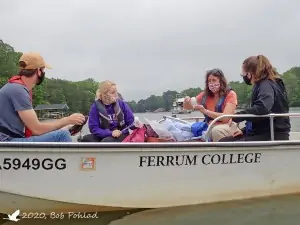
Ferrum College students work with Professor of Environmental Science Delia Heck during the 34th season of the Water Quality Monitoring Program. Left to right: Samuel Chappell; Michelle Musick; Delia Heck; and Chelsea Zizzi. Bob Pohlad photo.
Last week, the Smith Mountain Lake Association (SMLA) and Ferrum College Water Quality Monitoring Program began its 34th season. Since 1987, Ferrum College has worked with the SMLA to perform periodic testing of the lake water to help keep swimmers and boaters safer.
The Ferrum College portion of the team is made up of Program Director and Professor of Environmental Science and Natural Science Division Chair Delia Heck; Senior Scientist and Retired Professor Emeritus of Chemistry and Environmental Science David Johnson; Senior Scientist and Retired Professor Emeritus of Biology and Horticulture Bob Pohlad; Program Scientist and Assistant Professor of Biology and Horticulture Clay Britton; and Laboratory and Field Coordinator Carol Love.
Heck took over the director’s position after the January 2020 death of former Program Director and Retired Professor Emeritus of Environmental Science Carolyn Thomas. Thomas helped found the program.
This year, the team also consists fifty-four citizen scientists at Smith Mountain Lake who volunteer their time, and five paid Ferrum College student interns: senior Jacob Blaukovitch who is pursing a degree in chemistry, biology, and pre-professional health science (pre-med), with a one health minor; senior Lexi Davidson who is majoring in environmental science and minoring in biology; senior Michelle Musick who is earning an environmental science degree; senior Samuel Chappell who is majoring in environmental science and plans to graduate this December; and junior Chelsea Zizzi who is pursing a major in chemistry with a minor in English.
The Water Quality Monitoring Program is a labor of love for the Ferrum College team as it commands many hours during the summer months. “We test for bacteria every two weeks at fourteen sites with two stations at each site,” explained Heck. “We conduct depth profiles at five sites every two weeks. Our volunteers monitor and interns collect samples at fifty-six lake sites and twenty-two tributaries for trophic status monitoring.”
The team tests for e-Coli and other harmful bacteria. They also monitor algae biodiversity, watching for harmful algal blooms.
This year’s testing is even more complex than previous years due to COVID-19 restrictions. Heck said the team has developed safety protocols, including restricting interactions in the testing lab and with volunteers, implementing virtual training videos, rigid sanitizing, social distancing, wearing masks, and taking their temperatures daily. Each team member and volunteer also uses their own equipment including hand sanitizer, pens, personal flotation devices, and more.
Heck explained that water quality testing is not only important to keep swimmers and boaters safe, but is also an indicator of challenges in our environment. “Water is essential to our life on Earth. We face a changing climate and the interconnectedness between humans, health, and the environment are made clearer every day,” said Heck. “The project will continue to serve as an early warning sentinel as well as a model for how to to work collaboratively with our neighbors in living out our motto of Not Self, But Others. The partnership with the business sector, state government, and community exemplifies the very best Ferrum College has to offer our region.”
***
The 34th season of water quality monitoring has been dedicated to Carolyn Thomas, founding member of the program and beloved Ferrum College professor. The following statement was sent to this year’s citizen scientists in her honor:
“The Smith Mountain Lake Association and Ferrum College Water Quality Monitoring Program are dedicating the 2020 monitoring season to the memory of Dr. Carolyn Thomas, one of the founders of the program. Carolyn passed away in January after a courageous two-year battle with cancer. Carolyn’s passion for water quality was evident every time she ventured out on the lake. You can see that demonstrated in this interview with John Carlin from a few years ago.
“One of the traditions of the College’s sampling trips is to count great blue herons, Carolyn’s spirit animal. From now on when one is sighted we hope you will be reminded of Carolyn’s passion, her dedication to Smith Mountain Lake, and her love of citizen scientists like yourselves.”
Read more about the Smith Mountain Lake Association and Ferrum College Water Quality Monitoring Program here.
Ferrum College welcomes gifts made to the Carolyn Thomas Memorial Fund which supports students in the College’s Division of Natural Sciences. Please click here to make a gift in Thomas’s honor.
 A group of Ferrum College alumni and friends will travel to Rome, Italy this July 24 – 31, 2020.
The group, consisting of about eight to twelve people led by Ferrum College’s Assistant Professor of Religion Eric Vanden Eykel, will arrive in Rome on July 23. Their exploration of the Eternal City will begin on July 24, with authentic cuisine and visits to museums, archaeological sites, and churches.
Vanden Eykel has visited Rome before and will serve as the group’s tour guide. At Ferrum College, he teaches courses in biblical studies, archaeology, the historical Jesus, and world religions. He received his Ph.D. in Judaism and Christianity from Antiquity from Marquette University in Milwaukee in 2014. He also holds a Master of Art in biblical studies from Marquette and a Master of Divinity from the Candler School of Theology at Emory University in Atlanta.
Priority registration for alumni began on January 31, 2020. Registration to all interested parties will open on March 1, 2020.
To register, visit here.
Learn more about the trip here.
See photos from Vanden Eykel’s May 2019 trip to Rome here.